
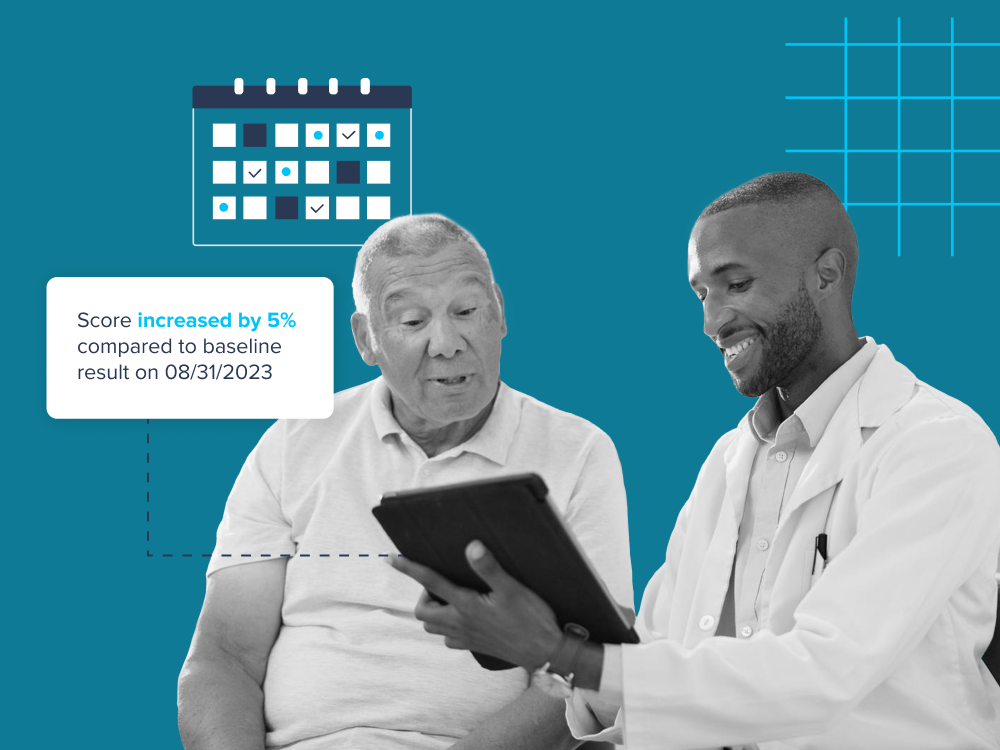
Routine cognitive assessment gives clinicians three things a one-off test cannot: a stable baseline for everyday health practices, better evidence for mental health diagnosis and treatment, and earlier detection of cognitive decline.
Currently, clinicians provide many services that are considered routine health care: vital sign measurements, blood work, and preventative screenings are all part of regular checkups.
Article Highlights
- Between 2015 and 2050, the share of the world's population over 60 will nearly double, from 12% to 22%.
- US adults experiencing anxiety or depressive disorders rose from 36.4% to 41.5% through the 2020 pandemic.
- Without a baseline, cognitive tests can only detect a deficit relative to the general population, not a change in the individual patient.
Brain health doesn't receive this same type of treatment, and cognitive assessment tools that establish a baseline are not commonplace in primary care, psychiatry, or neurology. Physicians often only take action when a patient has suffered a traumatic event or is experiencing obvious cognitive impairment. However, when we look at today's evolving patient populations, there's no question that standard healthcare practices should include brain health:
- Brain health concerns increase with age, and between 2015 and 2050, World Health Organization data project the proportion of the world's population over 60 will nearly double from 12% to 22%. As a result, healthcare worldwide needs to prepare its systems to handle an aging population.
- Brain health is impacted by common diseases, including COVID-19. One post-COVID study found that a year after infection, over 60% of patients experienced cognitive problems like trouble with short-term memory and planning.
- Brain injuries are not confined to athletes, and, in fact, most concussions are a result of falls, car accidents, and other common mishaps. Brain Pathology research found that 6% of the population, both athletes and non-athletes, show signs of chronic traumatic encephalopathy.
When should someone get a baseline assessment?
Five situations lead otherwise healthy people to establish a baseline and monitor cognitive function:
- A patient suspects they are at risk for mild cognitive impairment (MCI), Alzheimer's, or other types of dementia.
- A patient has experienced or is at risk for brain injuries resulting from activities such as sports and physical labor, or has a family history of stroke.
- A patient wants to keep their brain healthy as they age, or optimize their everyday performance.
- A patient is recovering from treatments that affect the brain, such as chemotherapy, anesthesia during surgery, or hormone therapy.
- A patient needs to confirm that cognitive capacity is sufficient or has returned to an acceptable level in areas where function is critical, such as working at dangerous job sites, making key decisions about finances, or getting back behind the wheel after an accident.
How does cognitive screening improve routine health practices?
Implementing cognitive care protocols as part of standard practice provides long-term insights that can only be seen if they're measured in the first place. For example, patients can be monitored for:
- General brain and mental health, as you would other annual assessments like blood tests and physicals.
- Long-term follow-up, for people who have experienced cognitive issues due to a past event, such as concussion recovery, chemotherapy-related "chemo brain," or "pumphead" issues after cardiac surgery, or whose treatment is ongoing, such as when taking medication for mental health conditions.
- Post-treatment status, to ensure a return to a stable baseline.
- Early warning signs, for those with a family history of conditions like Alzheimer's or other cognitive impairments.
It's hard to determine if there is a problem without a baseline measurement to compare to. Establishing a reliable baseline for a patient's cognitive function allows clinicians to easily perform all of the above and take a proactive approach to care.
How do cognitive tests improve mental health diagnosis and treatment?
Mental health conditions measurably affect cognitive function. Psychologists, psychiatrists, and neurologists routinely hear patients describe "brain fog," but these cognitive changes are sometimes subtle, often ill-defined, and rarely measured. Increased awareness about the tools that can support the public's mental health needs can help clinicians generate additional insights to provide the best possible diagnoses and treatments.
Three measures show the growing need for better mental health solutions:
- Through the 2020 pandemic, CDC surveillance data recorded the percentage of US adults experiencing anxiety or depressive disorders increasing from 36.4% to 41.5%, and those reporting an unmet mental healthcare need increasing from 9.2% to 11.7%.
- Between 2009 and 2015, an emergency department analysis found mental health-related visits increased by 56.4% for pediatric patients and 40.8% for adults.
- National prevalence data show the share of children ever diagnosed with ADHD increased by 42% between 2003 (7.8%) and 2011 (11.0%). For US adults aged 18 to 44, adult prevalence estimates put the lifetime prevalence of ADHD at 8.1%.
If a cognitive baseline is never established, when an event or episode does occur it's much more difficult for the clinician to determine the extent of cognitive change. In these cases, the clinician lacks data that could support a confident diagnosis.
In cases where a baseline is determined, when a patient experiences a decline, the clinician can easily detect this change and take action. When the patient's cognitive measurements return to a previously established level, the clinician's goals can vary: now they need to ensure the patient is remaining stable, ensure medications are not causing undesirable side effects, or look for early objective signs that the patient needs more care.
In all of these cases, cognitive monitoring can improve diagnosis of mental health conditions with cognitive symptoms and can give a clinician more confidence that their patient's mental health is stable or improving.
How does cognitive monitoring improve early detection of MCI?
Historically, early detection of mild cognitive impairment (MCI) has been challenging. Generally, it is only once symptoms have advanced that an MRI, Montreal Cognitive Assessment (MoCA), or Mini-Mental State Examination (MMSE) for dementia screening is done. Tracking patient status is complex, and MCI often goes undetected until it has progressed to the point of serious concern.
In addition, it is rare for physicians to collect a personalized baseline for their patients, so tests can often only detect a severe deficit relative to the general population. How do you determine what's "normal" for each patient? Start by establishing a baseline, which makes future assessments more relevant as personalized results can be compared to the patient's previous scores.
Cognitive assessments are critical measurements for brain health
Regularly scheduled cognitive function tests not only benefit clinicians who specialize in cognition but also provide an opportunity for other healthcare practitioners, such as primary care providers, to measure a core element of brain health in their routine care.
The Creyos platform takes seconds to set up, is engaging and enjoyable for patients, and produces a scientifically validated cognition assessment report in as little as 15 minutes. The solution makes it easy to establish reliable baselines for longitudinal monitoring to improve ongoing care and provides easy-to-understand reporting.
Plus, Creyos is designed with your practice as a business in mind:
- Reduced administrative burden with automated follow-ups and other automation workflows.
- Easy-to-use provider portal to access patient results and create pre-saved configurations.
- Simple pricing and reimbursement that uses a flat annual fee model and is reimbursable using various CPT codes through both public and private insurance.


Reviewed by Mike Battista, Director of Science & Research at Creyos
Mike Battista specializes in brain health, cognition, and neuropsychological testing. He received his PhD in personality and measurement psychology at Western University in 2010 and has been doing fun and useful stuff in the intersection between science and technology ever since.