How Eventus WholeHealth Unified Cognitive Assessment Across Long-Term Care
- ORGANIZATION
- Eventus WholeHealth
- PATIENT POPULATION
- Adults in long-term and post-acute care
- CARE MODEL
- Integrated primary care and behavioral health, value-based
- LOCATION
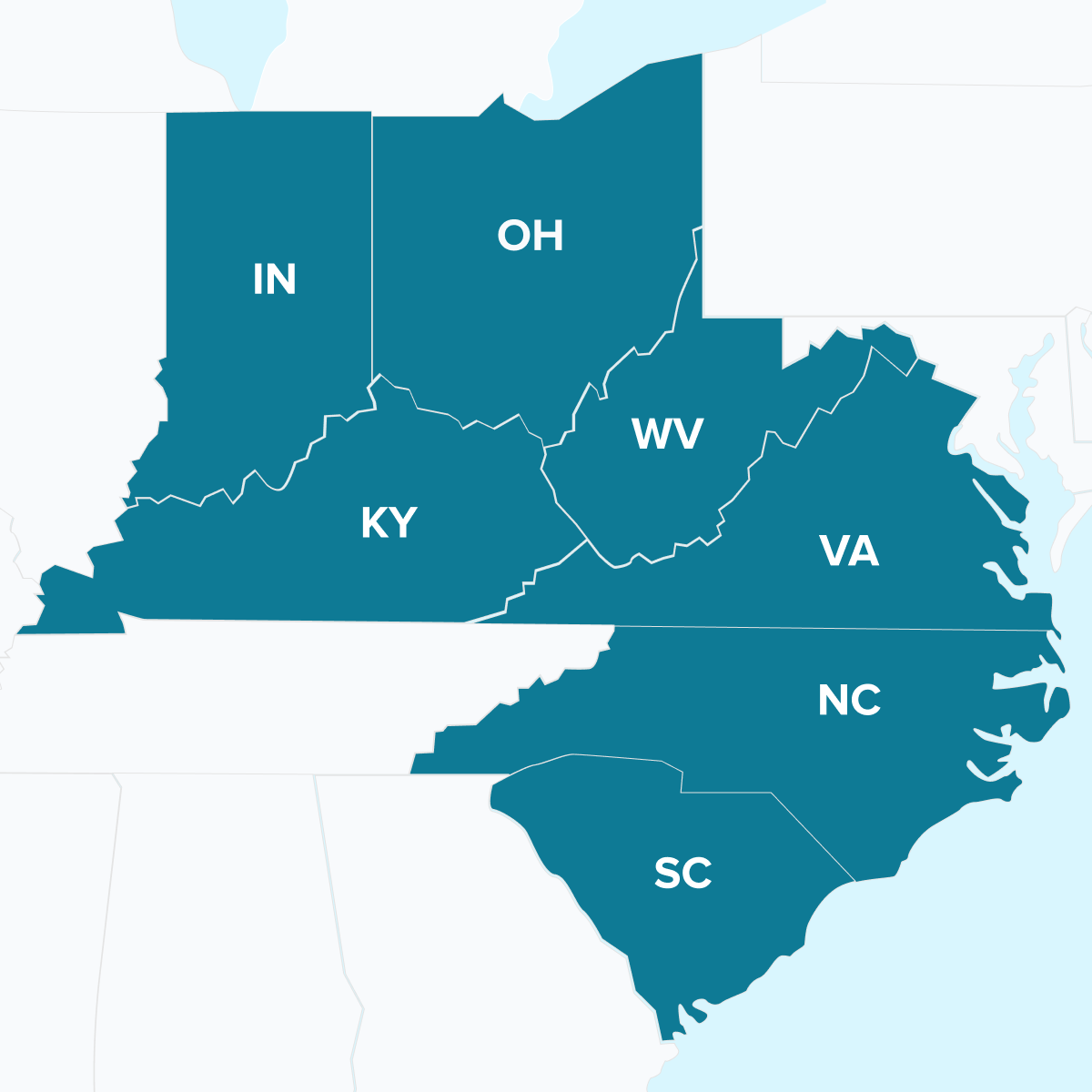
- NC, VA, WV, OH, KY, IN, SC
- CLINICAL SITES
- 1,100+ long-term care facilities
- CREYOS CUSTOMER SINCE
- 2025
for cognitive assessment were administered by Eventus clinicians in behavioral health, and assessment for residents seen only in primary care depended on referral. Some residents with cognitive needs went unassessed, and results varied by tool, limiting population-level tracking.
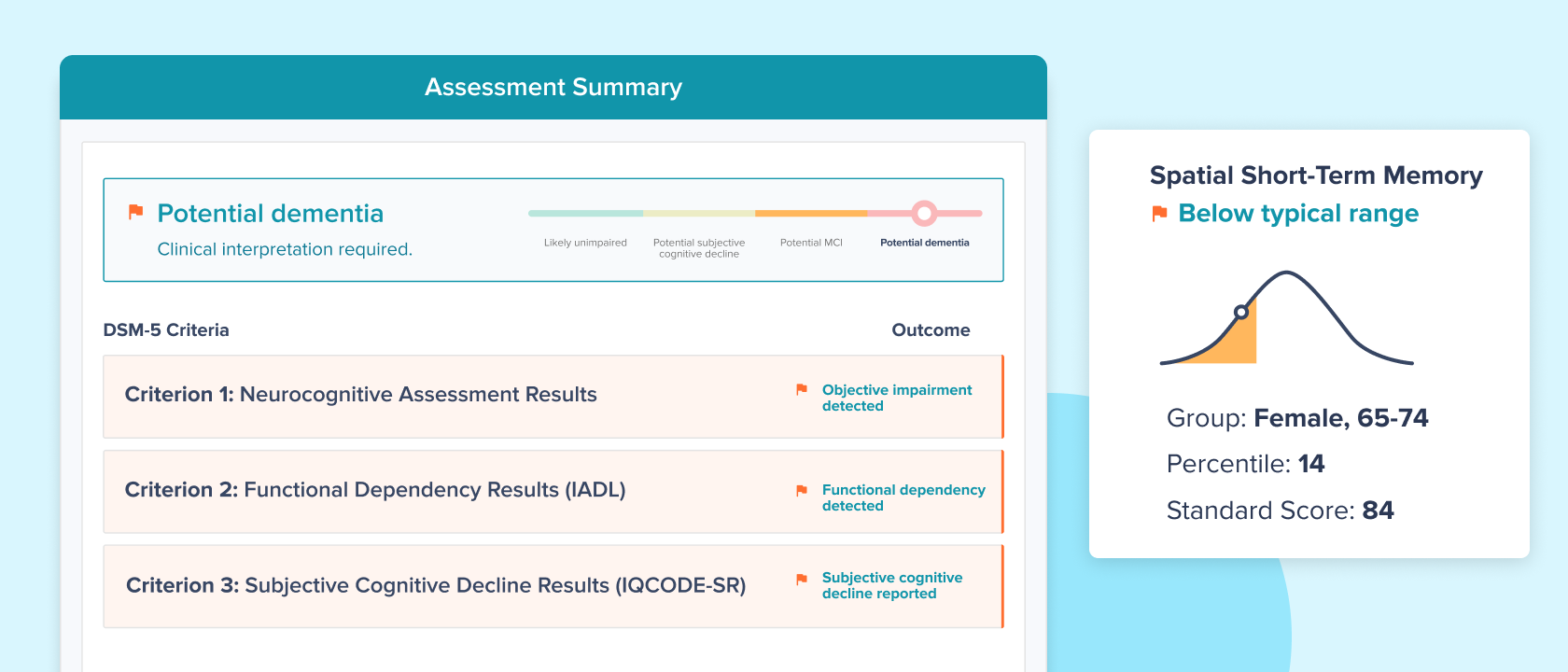
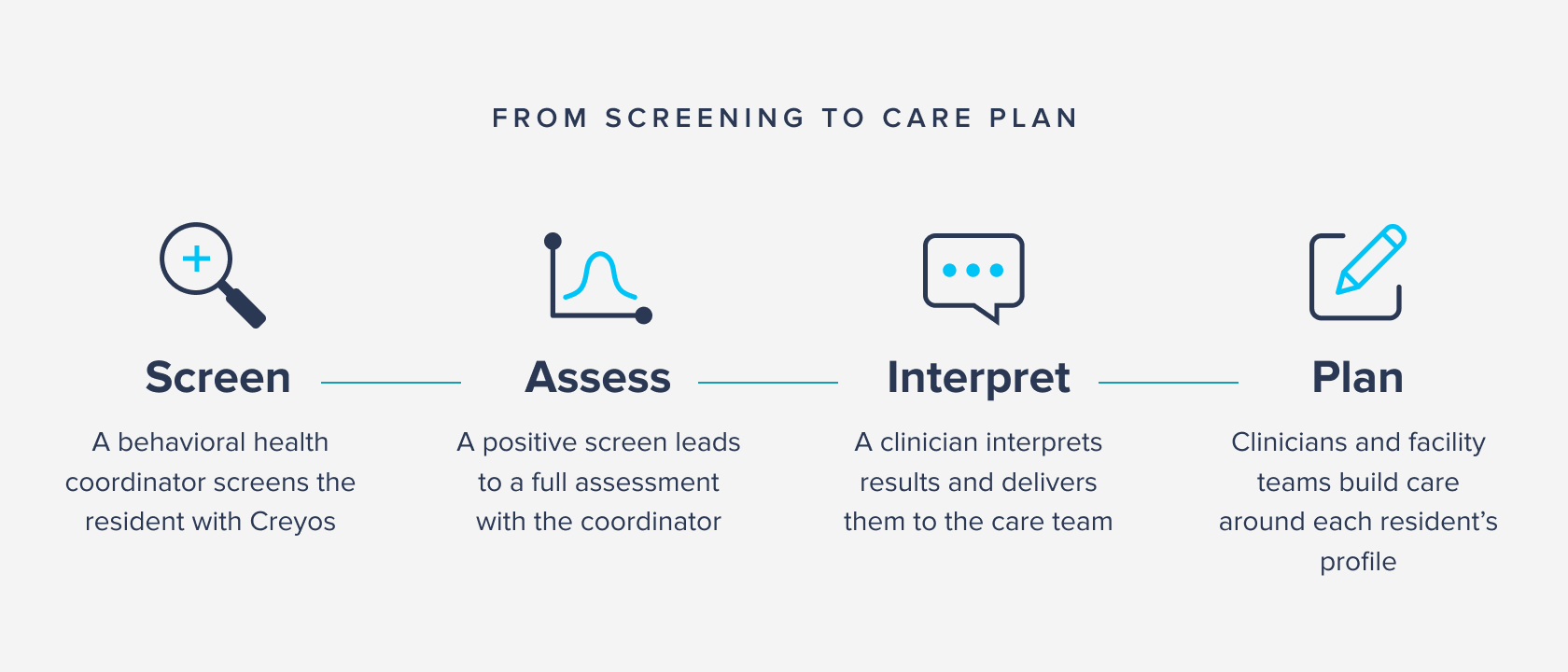
screen and follow-up assessment used consistently across primary care and behavioral health, each taking under 6 minutes and administered by behavioral health coordinators. Screening now reaches residents independent of referral and produces results comparable across the population.
whose screening called for further testing went on to complete a full assessment. Each result gives clinicians domain-level detail to support diagnosis and care planning, and adds to a shared record of cognition across the Eventus population.
"You want to know a patient’s strengths as well as their weaknesses. If I see somebody’s particularly impaired on memory but doing okay on language, that matters, not just to me, but to the facilities who care plan for these patients."
Integrated primary care and behavioral health, built for long-term care
Eventus WholeHealth is a physician-led organization providing in-person care to adults in skilled nursing, assisted living, and independent living communities. Founded in 2014, Eventus serves more than 58,000 patients each month across over 1,100 long-term care facilities in seven states. “We have two main service lines, primary care and behavioral health,” explains co-founder Dr. Jennifer Rucci. “And within behavioral health, we have psychotherapy and psychiatry medication services.”
A geriatric psychiatrist, Dr. Rucci helped build Eventus around a population she believes medicine has long underserved. “They’re the sickest people in this country, medically, and they have the least care, the least services,” she says.
Eventus patients range from adults in their 20s to older adults, and include both short-term rehab patients recovering after a hospital stay and long-term residents of nursing homes and assisted living. What they share, Dr. Rucci says, is the path that brought them there. “Patients don’t get here by their healthiest road of life,” she says. “Their health has been declining for a period of time leading up to this, both their physical health and their mental health or their cognitive status.”
“For the people who are here long-term, the nursing home is their place of residence. That’s their home. People have to always remember that this is where people live. It’s such an emotional thing, and I think people don’t always appreciate it.”
Cognitive assessment that varied by tool and depended on referral
“About half of our residents have mental health conditions of one kind or another, and about a third have cognitive conditions,” Dr. Rucci says. Understanding each resident’s cognitive status “helps direct all the rest of the treatment,” and moving clinicians past general descriptions toward a specific diagnosis is, in her words, “the big soapbox of mine.” As she explains, “Confused can mean a lot of different things.” Vascular dementia, Alzheimer’s disease, delirium, and depression can all present as confusion, and each calls for a different treatment plan.
Eventus trained its clinicians in cognitive assessment tools such as the BIMS, Frontal Assessment Battery, and clock drawing test, and the choice of tool varied from clinician to clinician. Assessment typically began once a resident was referred to behavioral health. For residents seen only in primary care, that referral depended on a clinician noticing a concern, so residents whose symptoms were quieter could go without one.
Dr. Rucci’s own chart reviews suggested that some primary care-only residents had cognitive concerns that had yet to be formally assessed. Where a diagnosis did exist, it was often nonspecific, such as dementia not otherwise specified. “Even within dementia, you need to know what kind of dementia,” she says. “The medications and the management depend on what type of dementia you have.” Eventus also needed a way to understand cognitive health across its entire population, which required measuring every resident the same way.
“If I have some people doing a BIMS, some doing an MMSE, and some doing a MoCA, everything’s different. How can I think about our population and its trends in a meaningful way as we move further down value-based care tracks?”
Two efforts that arrived at the same tool
Dr. Rucci was working with behavioral health leadership to unify cognitive screening across the organization. At the same time, Eventus enrolled in a partnered study with the American Medical Group Association (AMGA) focused on identifying cognitive impairment among residents receiving primary care only. Among study participants that are mostly ambulatory clinics and hospitals, Eventus was, in her words, “a bit of an odd bird.”
The study set a clear goal, though the approach was still open. “What tool were we going to use? How were we going to do it?” Dr. Rucci recalls. The behavioral health team had already found Creyos. “Then I thought, wait a second, this applies to our other work, too,” she says. Eventus merged the two efforts and made Creyos available to its entire population.
The cognitive assessment reports were central to that decision. “I specifically enjoyed how the cognitive domains were split out, because that helps to lead a patient-centered treatment plan,” she says. Applied consistently across Eventus, the same reports give the organization comparable data across its population, the foundation for the trend tracking it had in mind from the start.
“That’s one of the reasons we chose Creyos in the first place. I just really love the reports. I thought they were very meaningful.”
Behavioral health coordinators at the center of the rollout
Eventus built its rollout around its behavioral health coordinators, who administer the assessments, while a separate clinician interprets the results and, in Dr. Rucci’s words, “hand delivers” them to the clinician responsible for that resident’s care, ready to inform treatment.
The model has also worked well for the coordinators themselves, who “really enjoy performing the assessments and the interactions with the patients,” Dr. Rucci says. She notes that the work has “helped individual job satisfaction” across the team.
“Generally, the clinicians themselves really appreciated the extra information that was available to them for assessing these patients. For them, it’s an added benefit. They get information that helps guide treatment.”
Confirming the gap and guiding care for each resident
The pilot, which began in December 2025, confirmed what Dr. Rucci had been seeing in those charts. Screening identified primary care-only residents whose cognitive needs had yet to reach behavioral health. “That was point number one that we wanted to prove, and we have seen that,” she says.
With interpreted results in hand, Eventus clinicians can factor cognition into each resident’s broader treatment plan. “There’s so much overlap between their cognitive function and their medical function,” Dr. Rucci says. “Their cognitive function will impact how well they can handle other psychosocial treatments.”
The domain-level detail also shapes daily life for each resident. Facility teams use it to match activities to the abilities a resident has rather than the ones they’ve lost. “If they have spatial and motor challenges, the facility will give them one type of activity over another,” Dr. Rucci says. “It really does help.”
“It’s very helpful to have these results when we’re considering whether somebody should be placed in a memory care unit or a regular assisted living facility.”
The assessments have also strengthened how Eventus teams work together. Behavioral health coordinators now serve as a link between behavioral health clinicians and primary care, and conversations about a resident often begin with a Creyos result.
“I’ve seen really neat communications come about from the behavioral health coordinator to the behavioral health team and the primary care team as they’re discussing cases together. It has helped further integrate those service lines in a meaningful way.”
What consistent measurement makes possible
Residents and families have welcomed the assessments. “They like more things to be done. They’re looking for additional information,” Dr. Rucci says. One daughter asked for an assessment for her mother, who was already living in a memory care unit, because the family wanted “to understand the stage of where mom’s dementia is.” For residents, the visit itself carries value. “Patients are lonely,” she says. “Even just the interaction of performing the test is enjoyable to them, never mind the actual benefit of the results.”
Earlier identification also gives care teams time to act, in ways that depend on the type and stage of each resident’s condition. “It could mean different medications are used at a certain period of time,” Dr. Rucci says. “It could mean we bring in a cognitive therapist.”
The longer-term opportunity comes from repetition. “We expect to repeat this in our patient population year after year,” she says. Over time, that record will show how each resident’s cognition changes and, across the population, how residents fare under different treatments and care settings.
“We see this as more than a screening tool. We see it as an annual tool, where we can track trends over time.”