Skip to content
CASE STUDY

How Integrative Psychiatry Cut a Months-Long Testing Wait to Days

ORGANIZATION
Integrative Psychiatry
PATIENT POPULATION
Adults Across General and Complex Psychiatric Care
CARE MODEL
Outpatient Psychiatry and Interventional Neuromodulation
LOCATION
Louisville, KY
FEATURED CLINICIAN
Ali A. Farooqui, MD
CREYOS CUSTOMER SINCE
2024
Integrative Psychiatry Thumbnail
the challenge
1 to 3 months

wait for cognitive test results from external providers in Dr. Farooqui's community, for cases where the answer might change the treatment plan.

the solution
3 signals

beyond right or wrong answers: response time, answer changes, and impulsivity patterns, layered onto the full battery and Dr. Farooqui's clinical judgment.

the results
2 days

from a completed assessment to a treatment decision, limited only by scheduling rather than a referral queue.

"The greatest return has been in the confidence with which we know that we can deliver the testing we need to the people for whom it's appropriate. We've un-siloed cognitive testing by having it here."

— Ali Farooqui, MD
Integrative Psychiatry
THE COMPANY

Interventional psychiatry, with everything under one roof

Integrative Psychiatry in Louisville, Kentucky was among the first practices in the country to use transcranial magnetic stimulation (TMS) for psychiatric illness, starting in 2010. Today the practice offers TMS, ketamine infusion, and other neuromodulation treatments alongside traditional psychiatric care.

Its patients come in with depression, anxiety, obsessive-compulsive disorder (OCD), post-traumatic stress disorder (PTSD), and attention-deficit/hyperactivity disorder (ADHD). Dr. Ali A. Farooqui sees mental illness as a brain-based condition with biological foundations, so measuring accurately is part of treating well.

Clinic Map-2
THE CHALLENGE

Referring out for cognitive testing meant waiting months

Dr. Farooqui had recognized that a patient's cognitive function answers questions a clinical interview cannot settle on its own: the stage of a patient's disorder, and the story behind their symptoms. Two patients presenting with depression may need different treatment strategies depending on whether one of them shows a degree of cognitive slowing. Attention complaints may stem from an actual impairment or from a patient feeling overwhelmed. Those distinctions change what gets prescribed.

“Oftentimes, a clinical interview is not sufficient to get some of the inner workings of a patient's thought process. Structural and functional imaging are good for big-picture things but not thought processes. That's where cognitive testing comes in.”

Ali A. Farooqui, MD
Integrative Psychiatry

The testing methods available to him were outdated, restrictive, and difficult to access. Referring out meant waits of 1 to 3 months in his community, and the reports that came back were often long without being clinically actionable. That delay was a blocker for decisions the practice was otherwise equipped to make immediately.

“What differentiates one type of depression from another might be a degree of cognitive slowing. The depression's toll on the brain might be such that it's impacting their cognition. It's important to understand this because our treatment strategies will be different.”

Ali A. Farooqui, MD
Integrative Psychiatry
THE SOLUTION

Objective measurement, run from inside the practice

Dr. Farooqui came to Creyos already convinced of the value of cognitive testing. His experience with cognitive assessments in clinical trials, including National Institutes of Health (NIH) cognitive toolkits, meant the question was never whether to measure. It was finding a tool his practice could run itself.

Creyos fit on the criteria that mattered to him: accessible, scientifically rigorous, and flexible enough that patients could complete assessments in familiar environments rather than in a clinical setting.

The digital format also surfaces data a paper test cannot. Beyond whether an answer is right or wrong, the assessment captures how long a patient takes on a task, how often they change an answer, and patterns of impulsivity. Those signals help Dr. Farooqui distinguish between attention-related and impulsivity-based difficulties, and between a true cognitive impairment and the overwhelmed feeling that comes with anxiety.

“A lot of patients with anxiety will have this overwhelmed feeling, and it can become tricky, clinically, in an evaluation to differentiate between whether this is a mental and cognitive bandwidth issue or if it's truly an impairment issue.

The results of the Creyos test might steer me away from using a stimulant on some patients because the picture looks more consistent with pure anxiety and not a cognitive impairment that we associate with ADHD. Or, it might be the other way around.”

Ali A. Farooqui, MD
Integrative Psychiatry
Report with markers-1
THE IMPLEMENTATION

Where cognitive testing enters the care pathway

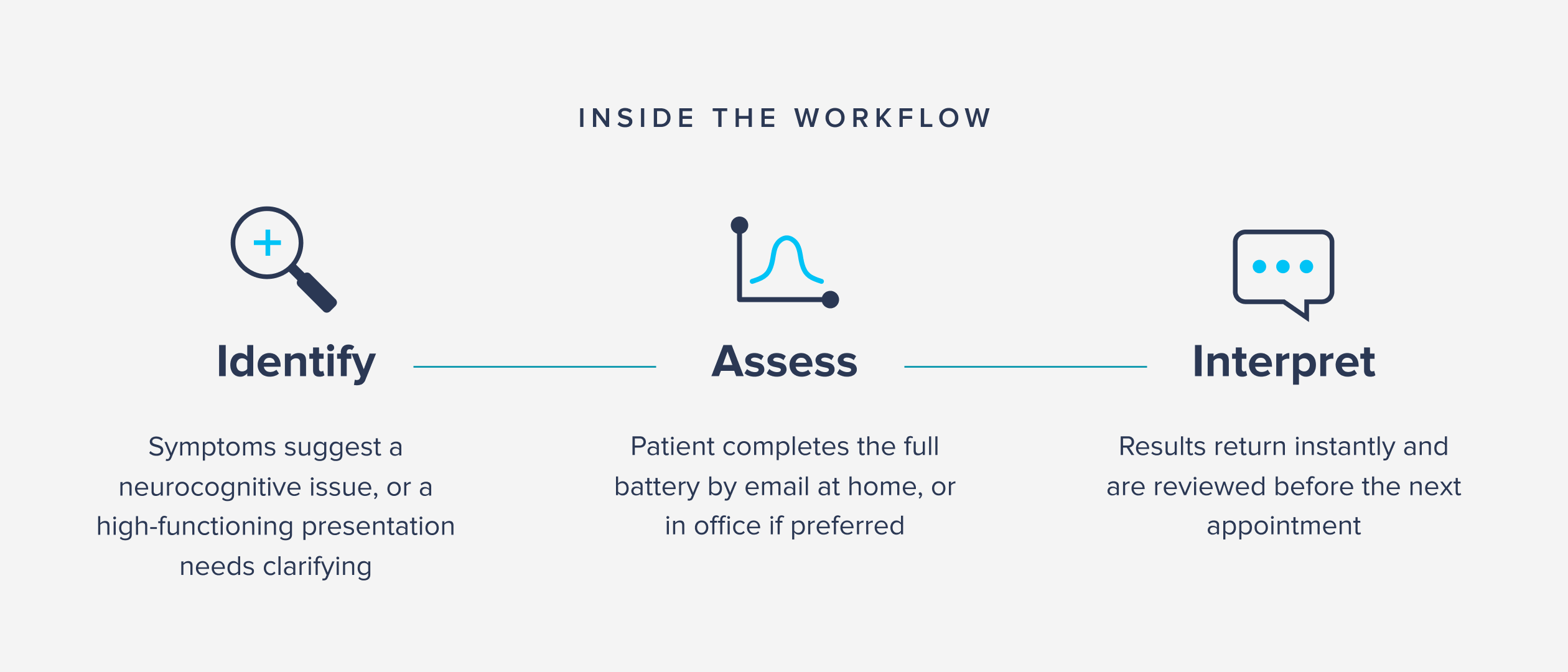
Dr. Farooqui considers cognitive testing when a patient presents symptoms that suggest a neurocognitive issue. It helps most with the cases that are hardest to read, particularly high-functioning patients who have developed compensatory strategies that mask their symptoms.

He administers the full Creyos battery, which gives him a complete cognitive profile to review. For patients where attention is the question, he adds the ADHD assessment for its additional digital task. Assessments go out by email for patients to complete at home, and testing is available in the office as well. Results are generated instantly, and he reviews them before the next appointment.

Integrative Psychiatry Workflow
THE RESULT

Decisions in days, not months

Bringing cognitive testing in-house collapsed the timeline. What had been a 1 to 3 month wait on an external provider can now be a decision within 2 days of a completed assessment, limited by scheduling rather than by referral queues.

Running the assessments himself also changed what comes back to him: clinically meaningful data he can act on, along with control over when and how patients complete them.

Patients have responded well to the testing, with no pushback and some requesting it out of curiosity. His clinic attracts people seeking a personalized, science-based approach, which makes objective measurement a natural fit.

“One of the reasons we offer a lot of our services in-house is because we don't want to wait months for one of our patients to get an evaluation that we think would be beneficial and might actually change the way that we are treating them. It made sense to bring cognitive testing in-house with Creyos because we can provide it in an accessible, flexible, and easy-to-use way.”

Ali A. Farooqui, MD
Integrative Psychiatry
THE IMPACT

Measurement as part of the wraparound

Cognitive testing now sits alongside the rest of what Integrative Psychiatry offers under one roof. When a clinical interview and imaging leave a patient's cognitive status unclear, the team can see patterns in attention, memory, and reasoning without referring the patient out.

Bring cognitive testing inside your practice

Talk to Our Team