How a Memory Clinic Serving 40+ Counties Took Cognitive Screening on the Road
- ORGANIZATION
- Texas Tech University Health Sciences Center
- PATIENT POPULATION
- Seniors
- CARE MODEL
- Rural, community-based cognitive screening
- LOCATION
- Lubbock, Texas
- COUNTIES SERVED
- 40+
- CREYOS CUSTOMER SINCE
- 2025
across 4 states, most with no structured cognitive screening infrastructure in place. Patients often reached care only after dementia had progressed to moderate or severe stages.
people screened in about a year by staff with no specialized testing training, using Creyos on an iPad to screen communities who were once hard to reach.
of those screened were flagged for cognitive impairment, most at an early stage, in a population that had gone unscreened before. Now they leave with a clear next step toward care.
"These are people who knew something was wrong. They noticed it, but they'd tell themselves it's normal aging. They used a lot of compensatory behaviors and kept it to themselves. And there was no system to catch it until they were in crisis."
A memory clinic built for one of the country's hardest-to-reach regions
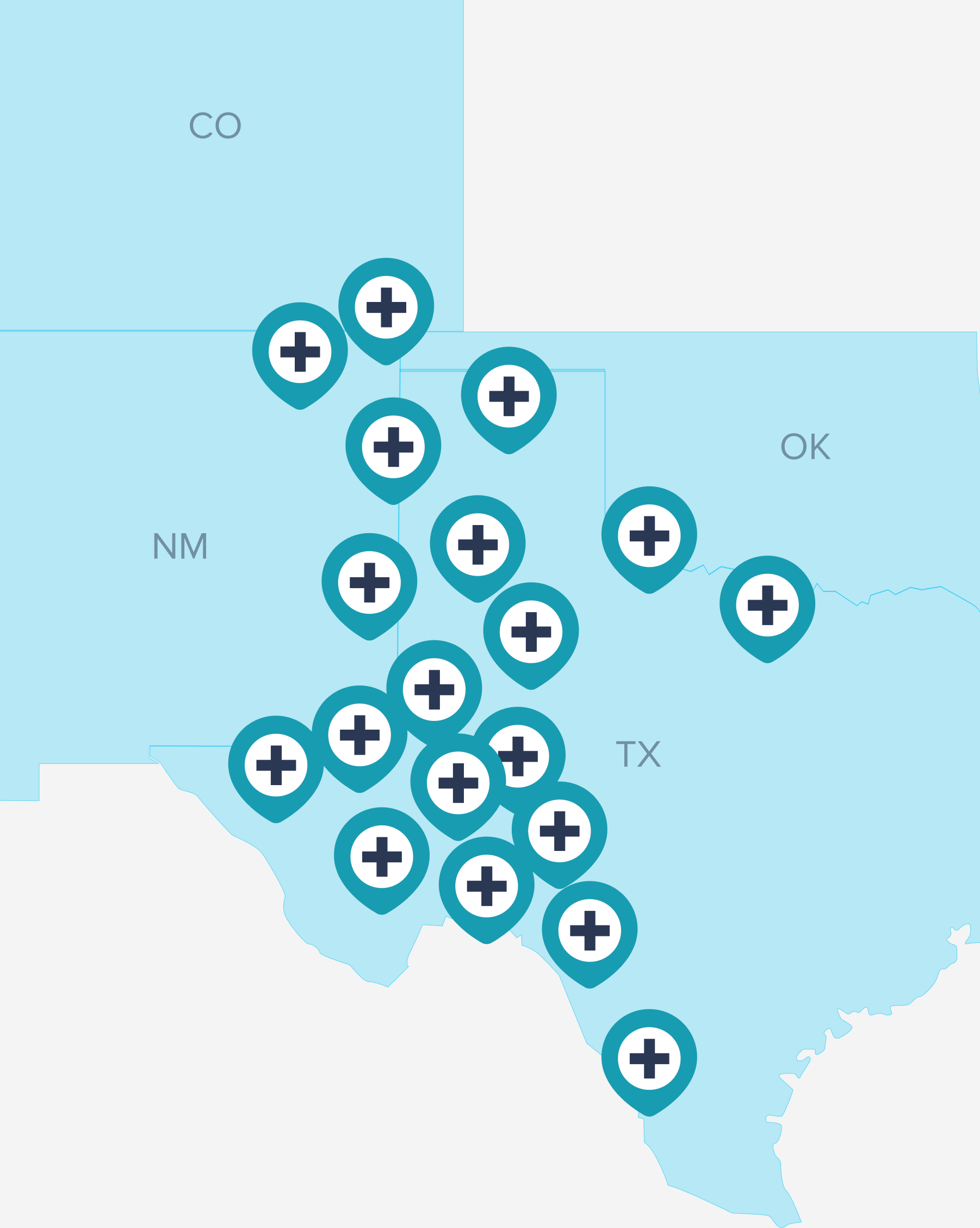
The Garrison Institute on Aging Memory Clinic, part of Texas Tech University Health Sciences Center in Lubbock, serves one of the most spread-out and underserved populations in the country: more than 40 counties across 4 states, much of it rural West Texas, largely Hispanic and often below the poverty line. Many of these communities sit hours from the nearest specialist, in a region the federal government designates as medically underserved.
"We serve 1.5 million people from a health care standpoint," says Dr. Jonathan Singer, who directs the clinic, "but we don't have the specialists to meet the need." Under his direction, the clinic provides comprehensive dementia evaluations for patients and families spread across that vast territory.
When screening programs don't exist, people arrive in crisis
Across the rural communities Dr. Singer's clinic serves, cognitive screening wasn't happening at all. Primary care physicians were the only realistic option, and they were already stretched too thin to take it on. "They'll say, ‘I'm a psychologist, I'm an oncologist, I'm an internal med doc, I'm a social worker, and I have 30 minutes at most with these patients,’" Dr. Singer says. "When we ask them to do one more thing, like screen everyone 60 and over, it's just too challenging."
So patients weren't reaching specialty care until a caregiver was overwhelmed and something had gone badly wrong. "They come to us in a crisis," Dr. Singer says. "The caregiver doesn't know what to do, they're dealing with challenging behaviors, the patient's never been diagnosed and is on no medication."
Treatments and interventions work best in the early stages of the disease, and increasingly that's also when patients remain eligible for them. When patients are reached late, the window in which screening could have changed the course of someone's care has usually closed, leaving management and supportive care where earlier action might have done more.
A screener report that maps to how a clinician thinks, in a form that travels
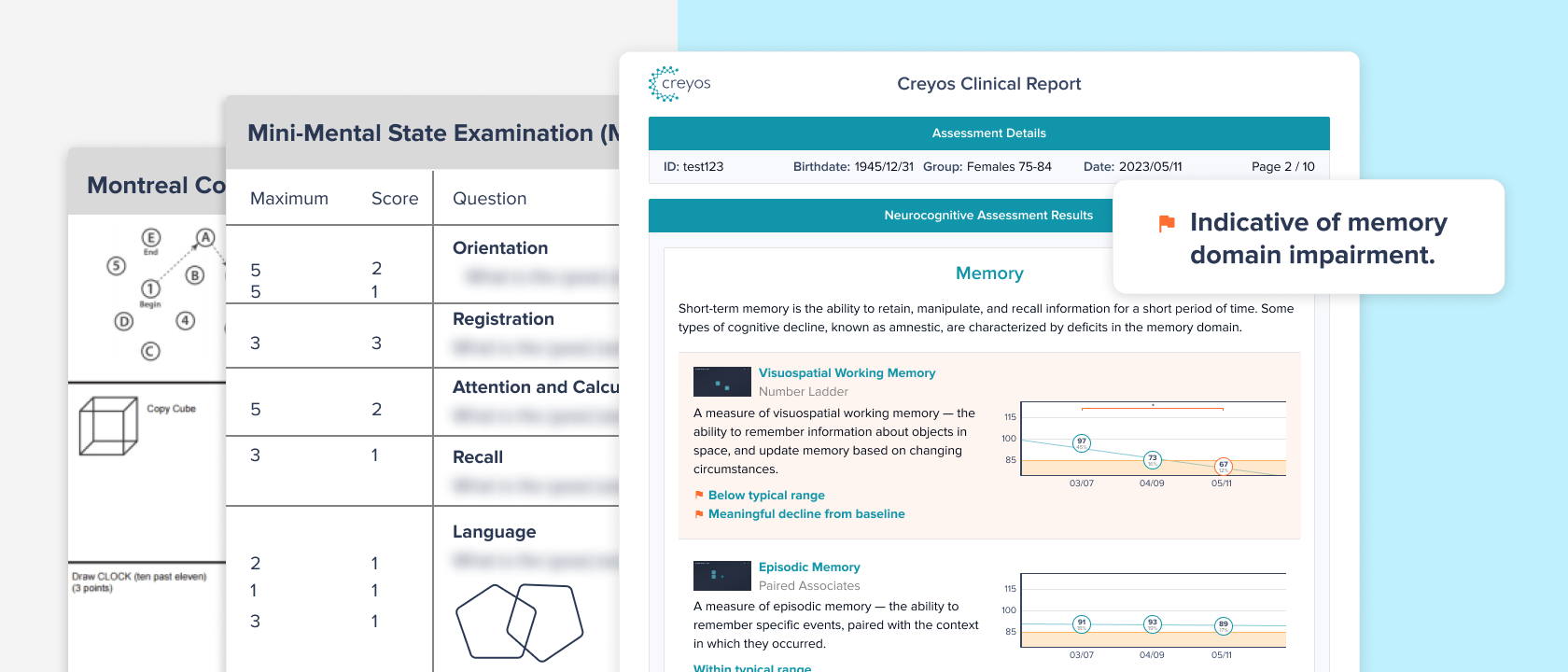
When evaluating tools for their rural screening program, Dr. Singer's first requirement was interpretability. Most screeners return a single score, and he finds that number tells him very little. "I've seen people who are really severe score a 28," he says, "and people who are okay score a 16."
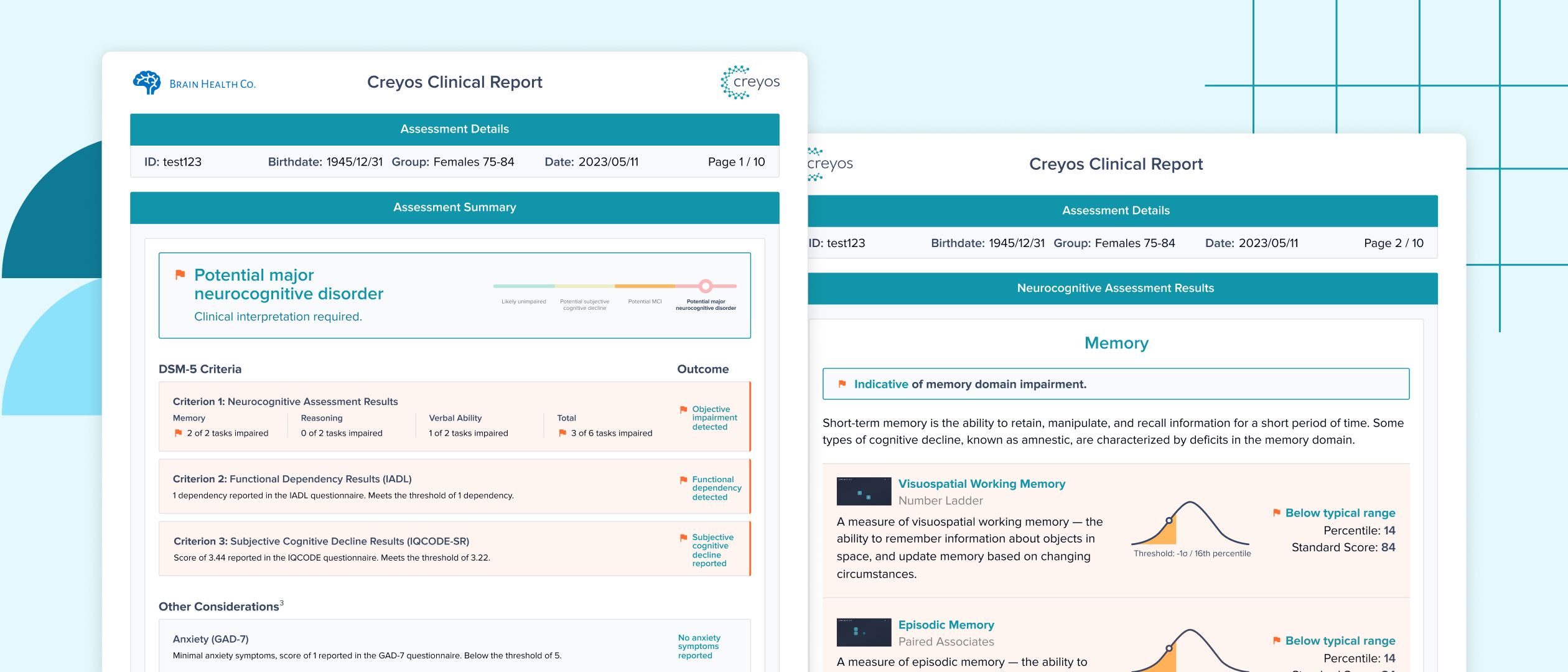
Creyos reports results by domain instead, separating attention, memory, and visuospatial function. In a library or a senior center, where screening conditions are rarely ideal, that separation lets him tell genuine cognitive impairment apart from a hearing problem or a lapse in attention. As he describes it, the domains let his team give patients an honest, strengths-based picture rather than a frightening number.
He viewed the 2-step design of the Creyos dementia protocol as another strength. "If they do really well on the first 2 tasks, that's all I see, and they're good," he explains. "If they don't, they do a longer assessment, and I see the fuller picture." A patient doing well finishes in a couple of minutes, while one closer to the threshold gets the added depth, without anyone sitting through more than they need.
"Traditional screeners give you a number, a 21 or a 22, and it doesn't tell you much. How scary is it to tell somebody they have cognitive impairment when it's really an attention issue? Seeing the cognitive domains affected changes that."
Bringing the assessment to where people already gather
The setting of a screening event rarely looks like a clinic. A recent event in Tahoka, Texas, took place in a public library, with the team setting up between the stacks. "There are books on both sides," Dr. Singer says, "and we're doing the screening right there." Others have run in senior centers and community halls, wherever the town’s community already gathers.
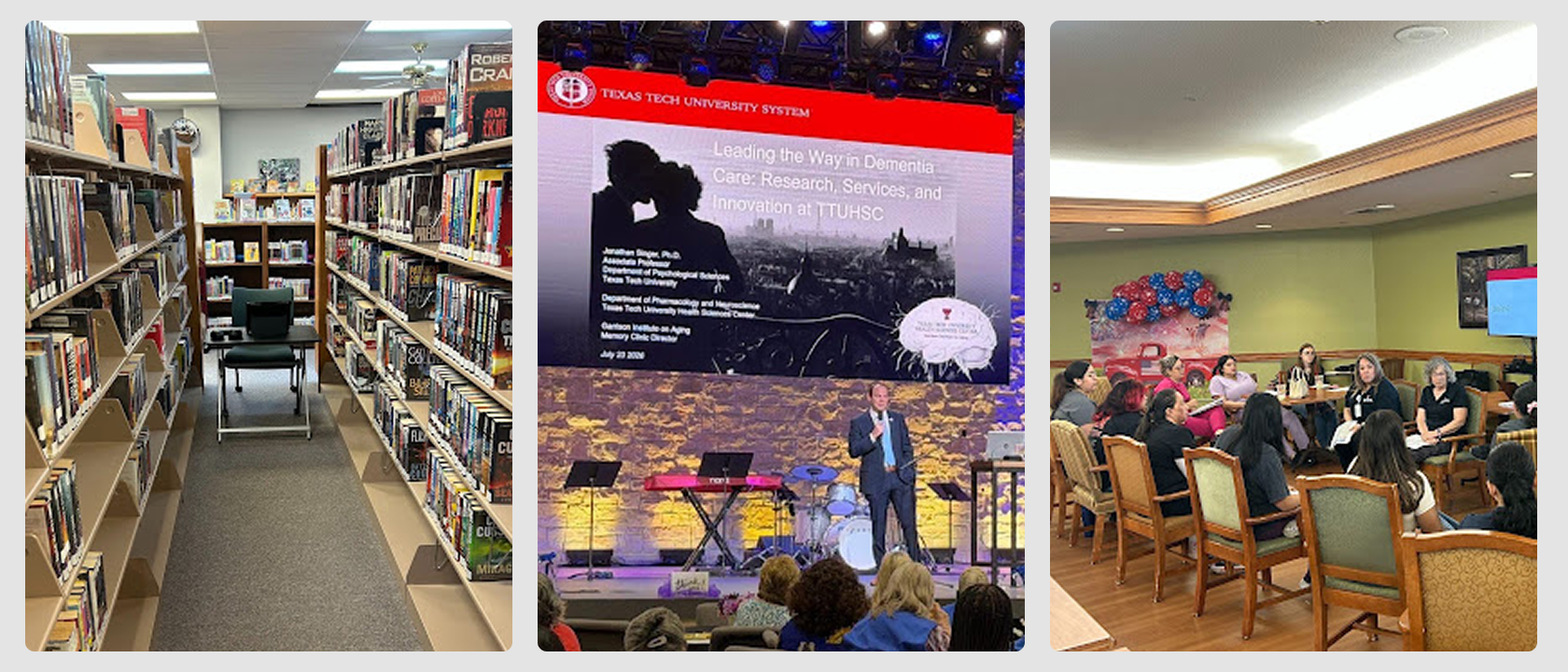
That improvisation is key to the program's success. "When you start talking about rural health, you have to be innovative," Dr. Singer says. Much of that innovation is about meeting people where they already are, and where they already feel safe. The team returns to the same communities over years, often working alongside a local library, physician, or community health worker people already know and trust.
"These are communities where if you just go there once, you're never going to get people," Dr. Singer says. "They're not going to trust you." Familiar surroundings lower the anxiety that keeps people from getting checked, and the proof is in the turnout: at community bingo nights, hosted by Dr. Singer’s team, he estimates that 80% to 90% of those who come to play also sit down to be screened.
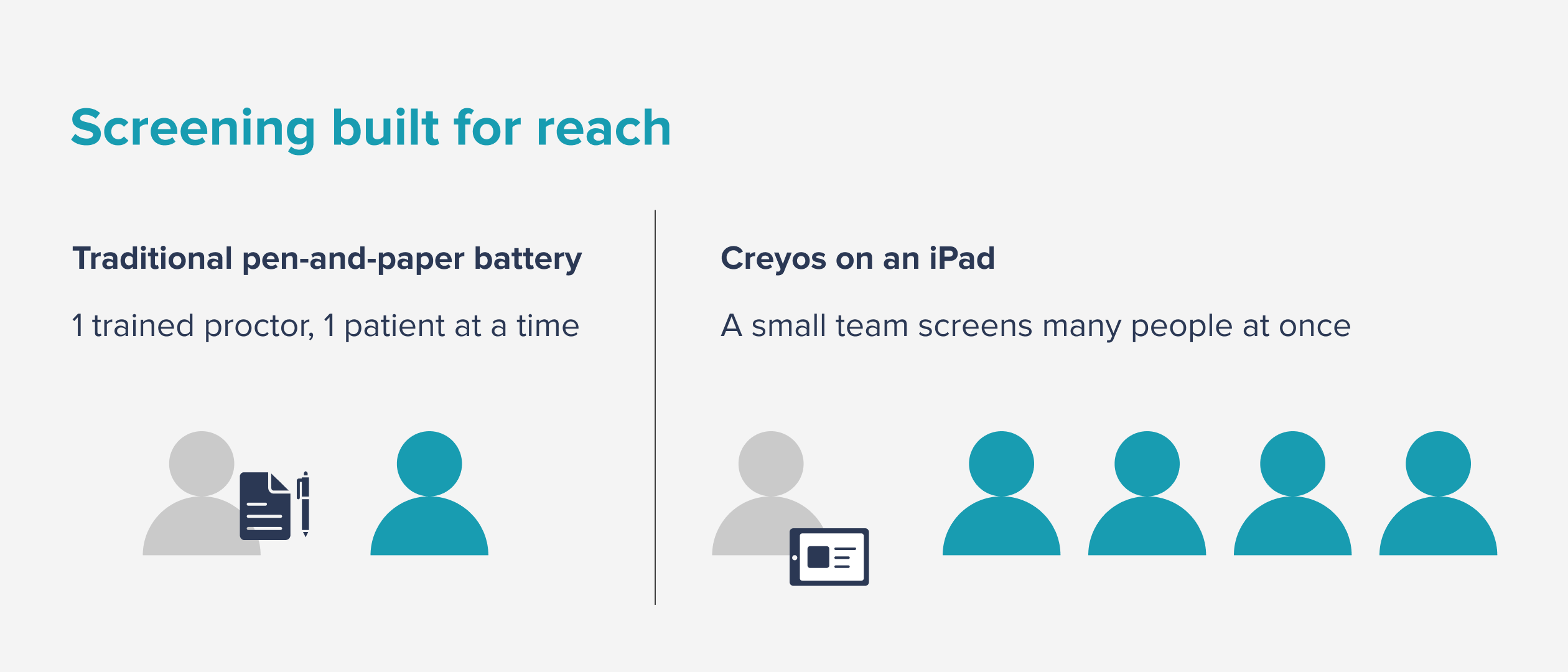
Given the varied assessment settings, the tool has to move as easily as the team does. Because the assessment runs on an iPad and is scored automatically, whoever administers it needs no specialized training, so his doctoral students, undergraduates, and coordinators can all run it. "With 3 of us, we can screen 40 or 50 people in the time it would take to sit 1-on-1 with a handful," he says.
"You don't need someone who's trained to give it. You just need someone who can use an iPad. Sign in, press play, and go."
Finding cognitive decline early, in people the system had missed
In about a year, Dr. Singer's team has screened more than 600 people across rural communities that had no cognitive screening before. The events vary widely in size, from about 10 people in a town of 900, where that turnout represents a real share of the eligible seniors, to more than 100 in a single day.
Roughly 1 in 4 of those screened are flagged for cognitive impairment, and at some events the rate has been higher. Many are people who, without a program like this, would not have been identified until their symptoms had advanced considerably.
The stage at which people are being identified is where the program shows its value. "Most of the people who take this are in the early stages," he says, with very few showing the severe deficits that are hardest to intervene on. The screening is surfacing cognitive decline while the signs are still subtle.
For patients, even a difficult result, Dr. Singer has found, tends to come as a kind of relief. "There's a validation," he says, "of 'I really do need to go see a neurologist,' rather than telling yourself it's just normal aging." For many, the screening puts words to something they had noticed in themselves and quietly set aside.
From finding people to reaching them in time
For Dr. Singer, the screening is only the beginning. His team now consents patients and follows up with everyone who screens positive, at 1 month and again at 3 months. "If they've engaged in care following their positive screener, great," he says. "And if they haven't, why not? What was the barrier?"
The plan is to turn each barrier they identify into a fix built into the screening and follow-up process itself. "It's identifying the barriers," he says, "and then creating interventions within our screening to help people access the care they need," whether that means adding a caregiver's contact or connecting someone to financial resources.
"What if the screening comes back clear? Then you know you're doing okay. And if it doesn't, we caught it early, and we can see what to do about it."
The approach is already moving beyond his own team. The university's rural health division sends a mobile unit deep into West Texas, and it is now being trained to screen cognition too. "We're training their staff to do our screenings with Creyos," he says. "We're excited to get it out into these really rural areas."
What he keeps returning to is the reach itself. "People are so thankful to even have a resource like this," he says, "in a town of a thousand people, where they don't have to travel to get it." With backing from philanthropy and university administration, the screening stays free to the communities it reaches, and Dr. Singer intends to keep widening that circle.