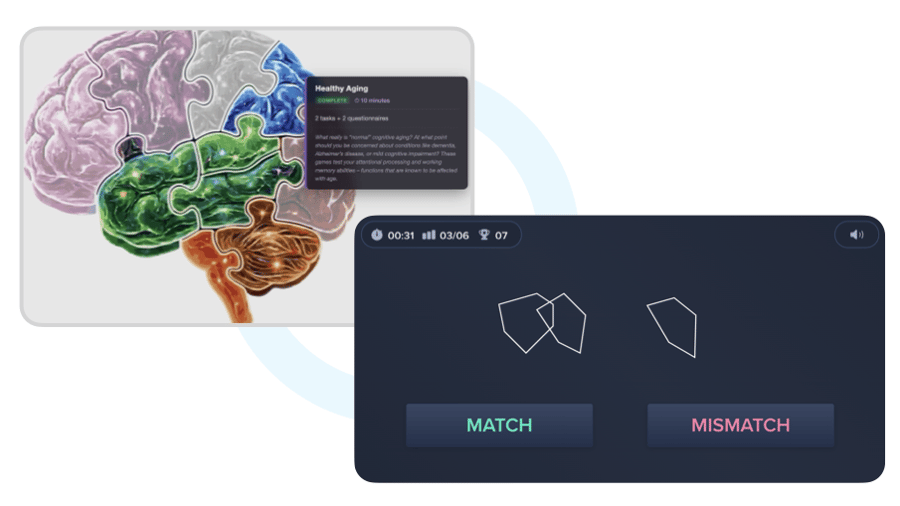
Can your brain stay healthy as you age? Take part in a pioneering study on lifestyle and healthy aging
Help neuroscientists uncover the links between aging, cognition, and lifestyle—and discover more about how your own brain is aging.



We still don’t know what “normal aging” looks like in the brain.
Scientists are starting to resist the idea that significant cognitive decline is a normal and inevitable part of getting older. Some key questions include:
- Can some people stay cognitively sharp well into old age by maintaining a healthy lifestyle?
- What is the line between normal aging and debilitating conditions like dementia
- What tools can be used to predict who is on track for a long and healthy old age?

These are fundamental questions that neuroscientists would like to answer—with your help.
Research has suggested that people who engage in healthy lifestyle habits have better memory and reasoning abilities than people who don’t. This study will extend those findings by testing the same research participants at two time points (now, and again one year later), precisely measuring changes in their cognition and lifestyle to get a better idea of what “normal aging” looks like.
Why should I participate?? ?
The Healthy Aging Brain Study (HABS)—which you can join by clicking the link below—is led by experienced researchers at Western University in Canada, led by Adrian Owen, professor of cognitive neuroscience and imaging and author of Think Before You Think: Understanding and Mastering Executive Function.
Everyone who takes part is helping to find the answers to key scientific questions, and you will receive personalized results about your brain health and lifestyle.
It’s fun and easy to take part! Contribute as much or as little as you’d like—there are different modules, games, and surveys to complete that will give you information about different aspects of your overall brain health. The more you complete, the more you’ll learn, and you can come back to do more whenever you’d like.