
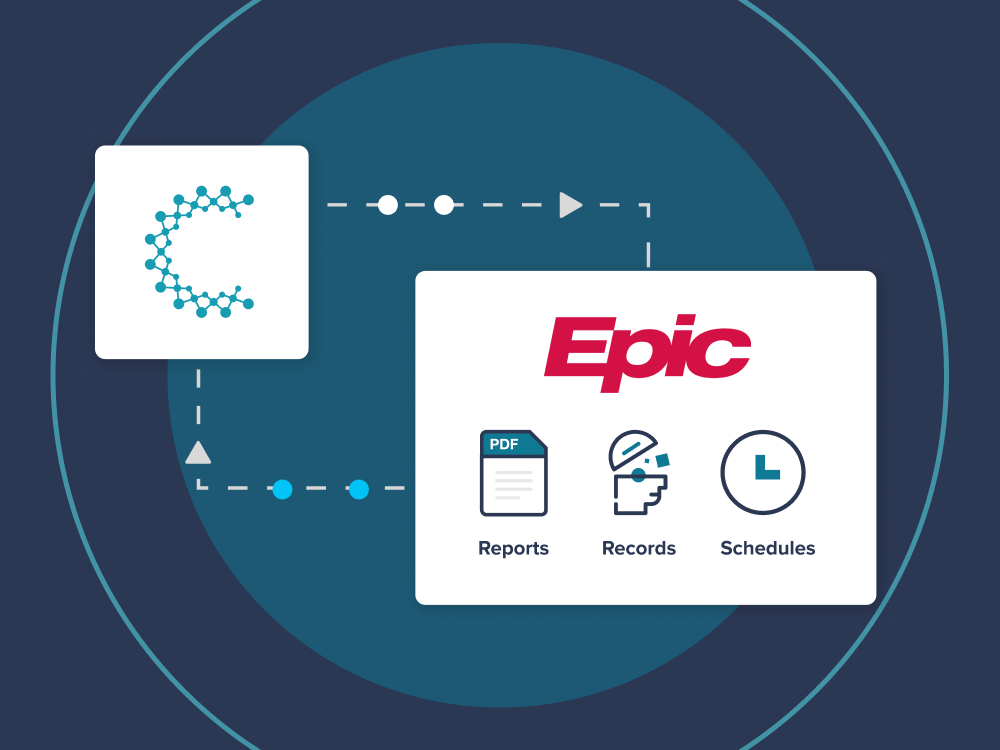
Creyos integrates directly with Epic, embedding cognitive assessment workflows into the clinical environment already used at the point of care. Built to align with existing workflows, security standards, and system-wide scalability requirements, the integration enables cognitive insights to flow into everyday care.
Electronic health record (EHR) systems serve as the central infrastructure for healthcare organizations, supporting clinical workflows, care coordination, and comprehensive patient records. Epic is the most widely adopted EHR, used by 42% of large healthcare organizations to manage complex, system-wide care delivery.
As cognitive data become increasingly available and important to patient care, they need to live within existing EHR systems to become part of routine clinical practice. The EHR is where administration workflows are defined, data access is governed, and population health initiatives are managed. Without integrated tools deployed at scale, adoption slows, workflows fragment, and valuable information risks being underused.
This article covers the workflow challenges of scaling cognitive assessment outside the EHR, how the Creyos Epic integration works, and its clinical, operational, and financial impact.
Article Highlights
Creyos integrates directly with Epic, with assessments administered in clinic or launched remotely via MyChart.
- Automatic patient matching eliminates duplicate documentation, and assessment data and reports flow directly into structured fields in the patient's chart.
- Disconnected tools add toggling and manual re-entry. One study found physicians spend nearly two hours in the EHR for every hour of direct patient care.
- Assessments take under five minutes, compared with the 10–15 minutes required to administer and score the Montreal Cognitive Assessment (MoCA).
Why is cognitive assessment hard to scale outside the EHR?
Large healthcare organizations face a familiar set of challenges when introducing new digital tools, especially when those tools operate outside the EHR. Digital health adoption is accelerating. In the AMA digital health study, physicians reported using an average of 3.8 digital health tools in 2022, a number that is significantly increasing year over year. This growing stack of tools makes it even more important that new solutions work with existing systems, rather than adding yet another platform for staff to manage.
Workflow fragmentation slows clinical efficiency
Disconnected systems duplicate documentation workflows, forcing clinicians to toggle between their EHR and other platforms to access and record information.
A study of physician time allocation found physicians spend nearly two hours in the EHR for every hour of direct patient care, with much of that time tied to documentation and administrative tasks. This constant toggling results in:
- Slower clinical and documentation workflows
- Increased cognitive load and frustration for clinicians
- Reduced time available for direct patient care
Over time, fragmentation strains care teams and undermines the consistency and quality of care delivery.
Manual processes increase risk of errors
When systems are not directly connected, manual data entry and duplicate documentation become unavoidable. Re-entering assessment results, copying information between platforms, and uploading reports separately all introduce opportunities for transcription error.
Even small documentation errors can have downstream consequences like additional staff time, diminished documentation quality, or disruptions to care coordination and clinical decision-making.
Disruption undermines adoption
Even clinically valuable tools can struggle with sustained adoption if they disrupt or add burdensome steps to established clinical workflows. When workflows feel disrupted, resistance grows. Healthcare executives are responding by prioritizing EHR-first adoption, with about 6 in 10 healthcare organizations choosing their EHR vendor's module when it's "good enough," according to healthcare IT investment research. The message is clear: if a solution doesn't fit naturally into existing workflows, it faces an uphill battle for adoption regardless of its clinical value.
Low sustained adoption prevents meaningful system-wide impact, including:
- Inconsistent use across teams
- Difficulty scaling beyond pilot programs
- Limited realization of clinical value
Without complete and consistent adoption, it also becomes significantly more challenging to demonstrate return on investment and long-term organizational benefit.
Siloed data limits organizational impact
One of the key advantages of scaled cognitive assessment is gaining population-level visibility. When cognitive data are centralized within the EHR, they can be analyzed alongside other clinical insights to inform quality initiatives and system-wide decision-making.
Without direct integration, it becomes difficult to aggregate structured data and generate meaningful system-level insights, limiting:
- Risk-stratification and visibility into population-level patterns
- Insight into trends across clinical and operational workflows and outcomes
- Consistent and controlled access to data
Without this data centralization, the broader strategic value of cognitive data is more difficult to fully realize.
How does Creyos integrate with Epic?
Creyos now integrates directly into Epic to improve clinical efficiency, eliminate manual entry, and centralize workflows and data. By embedding assessment processes into the Epic environment, cognitive insights become part of routine care.
The Epic-Creyos integration was purpose-built to enable:
- Flexible administration workflows: Creyos assessments integrate directly into established Epic workflows, with two ways to administer depending on clinical needs.
- In-clinic, healthcare professionals can initiate and administer the assessment during a patient visit that is already part of the care workflow, such as a routine annual wellness visit or a problem visit. The assessment is designed to be unsupervised, allowing patients to complete it independently during the rooming process while the medical assistant completes charting and other intake tasks.
- Assessments can also be launched remotely via MyChart, Epic's patient portal. Individual assessment links are generated for patients, allowing them to complete the assessment in advance of an appointment. This approach saves valuable in-clinic time while extending cognitive assessment beyond in-person visits, enabling health systems to scale screening and identify cognitive changes earlier across the patient population.
- Zero additional logins: Single sign-on (SSO) or secure, unique link access allows clinicians and patients to authenticate seamlessly through Epic or existing communication channels, reducing login friction and improving adoption.
- Automatic patient matching: Patient profiles are automatically created and matched from existing records in Epic, eliminating duplicate documentation and supporting workflows that systematically capture cognitive data across the patient population.
- Secure transfer and storage: Health Level Seven (HL7) messaging standards enable fast and secure information exchange. Creyos data are accessed within Epic, maintaining HIPAA and SOC 2 compliance.
- Automated results and data transfer: Assessment data and reports flow directly into structured fields in the patient's chart, maintaining a single patient record.
- Role-based permission hierarchy: Configurable access controls support appropriate data governance that matches Epic across clinical and administrative teams.
Together, these capabilities work to ensure cognitive data are securely collected in a way that is aligned with existing administration and documentation workflows, supporting easy implementation and adoption across the organization.
Clinical, operational, and financial impact of Epic integration
Embedding cognitive assessment directly within Epic is a strategic component for driving measurable impact across clinical, operational, and financial domains. Organizations integrating Creyos into their core infrastructure have demonstrated:
Reduced administrative burden
By aligning with existing clinical and documentation workflows, Creyos eliminates unnecessary steps and reduces disruption to visit flow. Assessments are completed through a patient-led workflow, scored instantly, and automatically transferred into the patient chart, taking under five minutes compared with the 10–15 minutes required to administer and score the Montreal Cognitive Assessment (MoCA).
Integrated workflows and automated data transfer reduce manual work, freeing clinicians and staff to focus on patient care.
Stronger organizational buy-in and adoption
Aligned, embedded workflows not only save time but also drive sustained adoption. When cognitive assessments fit naturally within existing systems and processes, care teams are more likely to use them consistently and see the additional value they add. At scale, consistent, organization-wide adoption will demonstrate the greatest return on investment, maximizing both clinical impact and operational value.
Data centralized where it matters for clinical impact
At the core of these initiatives is increasing visibility into cognitive health to support more proactive and effective care management. When cognitive data are centralized within the EHR, care teams gain access to high-quality, structured insights that inform clinical decision-making at the point of care.
At a population level, centralized data enable more precise risk stratification, helping organizations identify higher-risk groups, prioritize care management resources, and intervene earlier. In large health systems, implementing Creyos has increased detection rates of cognitive impairment by 5% or more, surfacing at-risk populations who may previously have gone unidentified. This improved visibility enables earlier intervention and supports better patient outcomes, which can reduce the overall cost of care.
Documentation that supports financial performance
Embedding cognitive assessment directly within Epic supports more consistent administration and standardized documentation across the organization. When workflows are aligned and structured data flow automatically into the patient chart, documentation is more complete, accurate, and reliable.
This consistency supports fee-for-service billing requirements and value-based care models while also providing defensible documentation in the event of audits. By driving consistent and reliable data, integrated workflows support measurable financial impact.
Delivering cognitive assessment at scale
Integrating Creyos with Epic brings cognitive data into the core infrastructure that healthcare organizations rely on every day. Embedding assessment directly into established workflows and systems makes cognitive insights a routine, scalable component of care.
The result is stronger adoption, measurable operational and financial impact, system-wide visibility, and better-informed clinical care across the organization.


Written by Anthony Chung, Director of Product at Creyos
Anthony Chung is Director of Product at Creyos, where he has spent over five years building cognitive assessment tools for clinicians and health systems. He leads product strategy and the roadmap, with a focus on AI-driven workflows, EHR integrations, and enterprise healthcare solutions.