
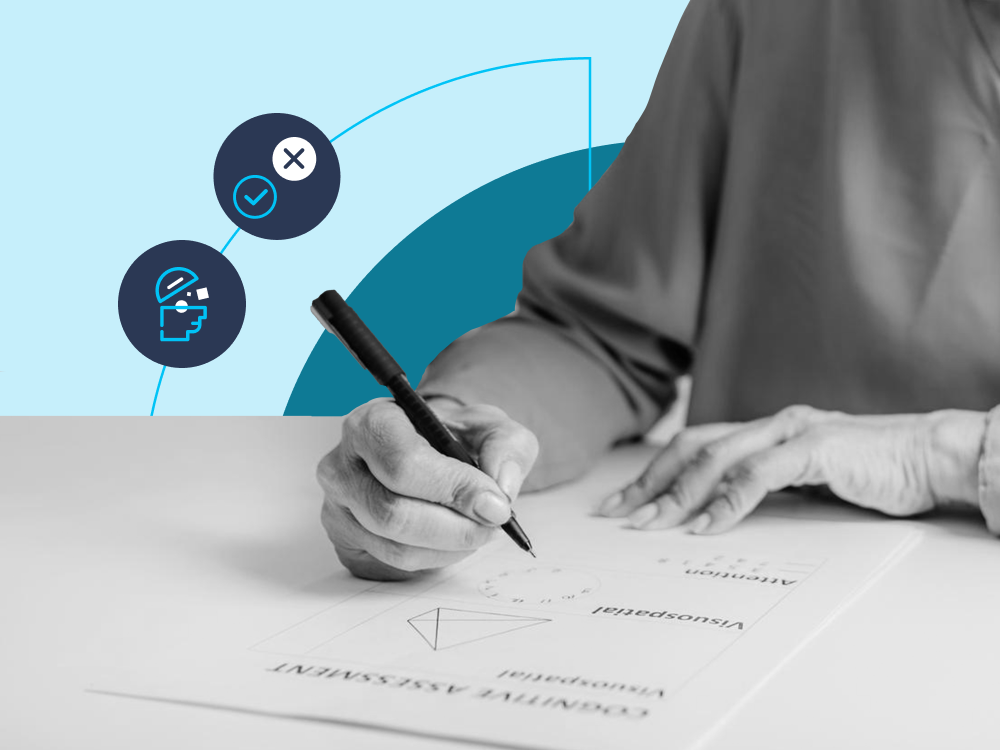
The Saint Louis University Mental Status (SLUMS) test is an 11-item cognitive screening tool that checks for signs of cognitive impairment in adults aged 60 and above, including dementia and Alzheimer's disease. It is a screener, not a diagnostic test: a SLUMS score indicates whether further testing is warranted, not whether a patient has dementia.
The test is free to use and convenient, but there remains an issue with underdiagnosis in primary care settings.
Providers must work to solve this issue. Patients with delayed Alzheimer's disease or dementia diagnoses are often left untreated while their impairment continues to lower their quality of life, straining family and caregivers.
Several factors contribute, including the stigma around cognitive health, a lack of reliable diagnostic tools, and many other contributing factors. While traditional screeners like the SLUMS can be an essential part of determining whether or not a patient is experiencing cognitive impairment, because of their limitations, they are better used as part of a larger diagnostic process.
Any single clinical evaluation, test or screener used in isolation poses a challenge for effectively diagnosing dementia, and the SLUMS test is no different. This is primarily because the SLUMS test can't always distinguish between dementia and other mental illnesses, making it important that providers follow up with further cognitive testing.
In this article, we cover the benefits and limitations of the SLUMS test and how it compares to other cognitive assessments, including digital cognitive assessments.
Article Highlights
The SLUMS test is an 11-item cognitive screener scored out of 30, administered by a healthcare professional in about seven to 10 minutes.
- Score interpretation uses two education-adjusted scales, one for patients who completed grade 12 or equivalent and one for those who did not.
- The SLUMS is validated for adults aged 60 and above and is free to use, but it is not validated for patients aged 59 and younger.
- SLUMS results indicate whether further testing is needed; they do not confirm or rule out a dementia diagnosis.
What tasks are part of the SLUMS test?
When it comes to the actual process of scoring the SLUMS test, healthcare professionals can expect to ask the patient a set of 11 questions, with the SLUMS score ranging from 0 to 30. These questions are designed to measure the following cognitive domains:
- Questions 1-3: Orientation
- Questions 4 and 7: Short-term memory and delayed recall
- Question 5: Numeric calculation
- Question 6: Language and verbal fluency
- Question 8: Working memory
- Questions 9 and 10: Executive function and visuospatial ability
- Question 11: Immediate recall, executive function, and extrapolation or abstract thinking
How is the SLUMS test scored?
SLUMS scoring is the process of interpreting a patient's responses to the test's 11 questions, with the goal of measuring their cognitive abilities. The test has a maximum score of 30. The purpose of the SLUMS score is to provide primary care providers (PCPs) with information on a patient's cognitive abilities to support the detection of mild cognitive impairment, also called mild neurocognitive disorder, or dementia.
The test and its scoring method were originally developed at the Saint Louis University School of Medicine in 2006. It is a scientifically validated cognitive screener for dementia and other cognitive impairments in elderly patients aged 60 and above. It's important to note that the test is not validated for patients aged 59 and younger.
For patients who suspect they may have a cognitive impairment, taking the SLUMS is a quick and convenient process. This may make it a more appealing cognitive assessment compared to hours-long, intensive neuropsychological exams. However, the test is best followed up with further testing to garner the detailed information needed to make a confident diagnosis.
Who administers and scores the SLUMS?
The SLUMS test is scored by a trained healthcare professional, usually a physician, nurse practitioner, or allied provider. The test's questions and score are also given cutoffs adjusted for education level. Overall, the entire process takes about seven to 10 minutes.
SLUMS score interpretation by education level
SLUMS scoring is broken down into two scales, one for patients without a complete high school education and another for those with a high school education or greater. It's the healthcare provider's responsibility to score the patient's answer and measure the results appropriately based on their education level.
| SLUMS score | Less than high school education | High school education or greater |
|---|---|---|
| Normal cognitive function | 25 to 30 | 27 to 30 |
| Mild cognitive impairment (mild neurocognitive disorder) | 20 to 24 | 21 to 26 |
| Possible dementia | 1 to 19 | 1 to 20 |
The test's use of fixed cutoff scores to categorize cognitive status may oversimplify complex cognitive profiles, especially in borderline cases where a patient may score just above or below a diagnostic line. This demarcation for normal cognitive function vs. mild cognitive impairment becomes even less clear when comorbid disorders, like depression, are introduced, with a cutoff of 25 recommended in one Clinical Gerontologist study.
In contrast, the Creyos platform uses large normative datasets to interpret scores dynamically and objectively, placing an individual's performance in the context of thousands of peers. This approach improves precision and reduces reliance on clinical intuition, helping frontline providers detect early cognitive decline with less ambiguity.
What can skew a SLUMS score?
SLUMS results can be skewed if the patient has:
- Language or cultural barriers with the physician.
- Vision or hearing impairments.
- Existing mental conditions.
Where SLUMS scoring gets subjective
Scoring the SLUMS has its limitations, making more comprehensive follow-up testing necessary. There are many reasons why patients may score low on the test. These are just a few of the factors that may impact a patient's score:
- Clock drawing: this test assesses visuospatial and executive function. Scoring depends on the correct spacing of hour markers and visual depictions of the time ten minutes to eleven o'clock. This requires a bit of subjectivity and judgment on the scorer's part because a patient may know what the question is asking and how to deliver the answer but may lack the drawing skills necessary to accurately depict it.
- Story recall: this test assesses memory and comprehension. Some patients struggle not because of cognitive issues, but because the story ("Jill the stockbroker") is unfamiliar or unrelatable, especially for those with low literacy or education or who are simply too distanced by the premise of the story to have significant meaning to them.
Overall, the SLUMS is a brief, validated test for approximating global cognitive functioning among older adults. However, it does have some subjective limitations in its scoring method that physicians and patients need to be made aware of to increase the likelihood of accurate results.
What are the strengths and limitations of the SLUMS test?
The SLUMS is a valuable tool for initial cognitive screening, but it isn't definitive. If the assessment detects potential cognitive impairment, it may indicate the need for further evaluation to better understand the patient's cognitive health.
Before a primary care physician decides whether the SLUMS test is the right cognitive screener for a patient, they need to gain a complete understanding of its strengths and limitations.
Here's a breakdown of what healthcare providers can expect:
SLUMS strengths
- Wide coverage of cognitive domains: unlike the MoCA and MMSE, the SLUMS tests for extrapolation skills with the story task. Additionally, it may be an even more accurate cognitive screening tool compared with the MMSE.
- Quick to administer: taking only 10 minutes, the SLUMS is as fast or faster than comparable pen-and-paper cognitive screeners like the MoCA and the MMSE, which each take about 10 minutes.
- Easy to interpret: the SLUMS is relatively easy to interpret, and healthcare providers can usually make an interpretation as soon as testing is complete.
SLUMS limitations
The SLUMS test, like all diagnostic tools, has its limitations. These limitations include age range constraints, limited sensitivity, insufficient normative data, limited criterion validation, a lack of detail, and pen-and-paper administration.
- Only for certain patient groups: the SLUMS examination is designed strictly for patient groups aged 60 and above. Additionally, it's only been translated into a limited number of languages. This means it may overdiagnose impairments in non-white patients. The test has also been studied less with women than with men.
- Lacks sensitivity for MCI: while the SLUMS performs reasonably well in detecting dementia, its sensitivity is lower when identifying mild cognitive impairment. This means that, while SLUMS may be effective in recognizing more advanced cognitive decline, its ability to detect earlier, subtler signs, those seen before an MCI diagnosis, is still unclear.
- Insufficient normative data: there is a lack of comprehensive reference scores based on large, demographically diverse populations.
- Lack of reliable data: limited evidence exists regarding test-retest reliability.
- Limited criterion validation: few studies have used objective measures (like neuroimaging or biomarkers) to confirm the SLUMS examination's diagnostic accuracy.
- Lack of detail: SLUMS can only determine if a patient is cognitively impaired or not; it can't deliver the more detailed and specific results required for a physician to make a diagnosis.
- Pen and paper: like other traditional cognitive tests, the SLUMS is usually administered via pen and paper, inconveniencing the patient with a trip to the clinic.
How does the SLUMS compare to other cognitive tests for MCI?
When it comes to detecting and monitoring the signs of cognitive decline in older patients, the SLUMS test is just one of many cognitive tests for dementia available for healthcare providers and patients. So, how does it compare to other cognitive assessments?
| Test | Administration | Time | Score |
|---|---|---|---|
| SLUMS | Clinician-administered | 7 to 10 minutes | Up to 30 |
| MMSE | Clinician-administered | 5 to 10 minutes | Up to 30 |
| MoCA | Clinician-administered, in person or online | About 10 minutes | Up to 30 |
| SAGE | Self-administered, clinician-interpreted | 10 to 15 minutes | Up to 22 |
Here's a closer look at each of these cognitive exams as a point of comparison:
Mini-Mental State Examination (MMSE)
The Mini-Mental State Examination (MMSE) is one of the most widely used cognitive screening tools in the world and is available in a wide variety of languages. The test can be conducted in five to 10 minutes and assigns up to 30 points for task completion, assessing various cognitive domains, including memory, attention, language, and spatial orientation.
While both the SLUMS and MMSE tests take around the same time to conduct and interpret, the SLUMS includes different types of questions, like story comprehension. On top of that, the MMSE may be less sensitive than the SLUMS in certain applications.
Montreal Cognitive Assessment (MoCA)
The Montreal Cognitive Assessment (MoCA) is another commonly used screening tool for mild cognitive impairment and dementia. Like the SLUMS, it's designed to identify early cognitive deficits, with a strong focus on executive function, attention, and memory. The test is widely available to many different patient groups, either in person or online, with options available for people with low or no vision and those who are experiencing hearing loss.
The MoCA offers a greater degree of accessibility than the SLUMS. The MoCA has been better studied in academic literature, but the SLUMS is free to use. Depending on a PCP's requirements, both tests have their applications, but both screeners also have certain limitations.
Self-Administered Gerocognitive Examination (SAGE)
The SAGE is unique because it can be completed by the patient alone, offering a way for individuals to test their cognitive abilities on their own time. However, the results still need to be interpreted by a healthcare professional. It assesses memory, problem-solving, and verbal reasoning and is available in four variations, allowing patients themselves to retest for consistent results.
The SAGE has similar accuracy to other pen-and-paper screeners; its key difference from physician-administered screeners like the SLUMS is that the SAGE test is a self-assessment tool. That being said, the SAGE still requires manually responding to items on paper and manual scoring and shares many of the same limitations as other pen-and-paper screening tools.
When should healthcare professionals use the SLUMS versus a digital cognitive assessment?
While the SLUMS can be a useful tool for screening cognitive impairment in general, some senior-focused primary care organizations recognize its limitations in confirming or ruling out a dementia diagnosis. These organizations opt to use digital cognitive assessments as an alternative.
While the SLUMS test has its uses as a cognitive screener, healthcare providers may want to consider additional or alternative options, like the Creyos digital cognitive assessments. These computerized cognitive assessments offer a more detailed report than the SLUMS test.
Additionally, Creyos cognitive assessments are scored automatically and are accessible to patients of all ages and ability levels. They are also fully capable of retesting without needing multiple variations. Creyos cognitive assessments are able to detect the early signs of cognitive decline, allowing for early dementia prevention or intervention before a patient's condition deteriorates.

The Creyos dementia screener, assessment, and care plan
Creyos has a variety of cognitive assessment solutions and condition-focused protocols that are readily available for healthcare practitioners, including PCPs. Physicians can support their clinical evaluation with the Creyos dementia assessment, helping them act sooner before their patients' conditions further deteriorate.
Dementia screener
This two-task digital cognitive screener is not only faster, taking less than three minutes to complete, but also more advanced. It uses machine learning to detect the subtle signs of cognitive impairment, confirming whether the patient needs further testing. It is self-administered, so it can be completed without supervision in a clinic or from the comfort of the patient's own home.
It includes two validated tasks that assess working memory and attention, two cognitive skills known to be sensitive to early-stage dementia.
Each task takes just a few minutes to complete, with results scored and compared against Creyos's large normative database. Results are visualized in a structured report that highlights whether a patient's performance falls within the expected range or shows patterns consistent with cognitive decline.
Dementia care plan
The Creyos dementia assessment also comes with a cognitive care planning function. The care plan is based on guidelines by the Alzheimer's Association and allows physicians to collect longitudinal data over time, supporting them in making critical clinical decisions with their patients.
It's a structured step-by-step digital template that follows Alzheimer's Association guidelines, prompting providers to cover:
- Cognitive status
- Functional status
- Behavioral and neuropsychiatric status
- Medication
- Caregiver needs
- Safety
- Advance care planning
It includes structured patient and caregiver sections that help evaluate functional abilities (IADL, DSRS), caregiver stress, education, and support resources. It also meets CPT 99483 billing requirements.
When to use Creyos
Compared to traditional pen-and-paper cognitive screeners like the SLUMS, the digital cognitive testing from Creyos can provide healthcare professionals with more detailed insight into a patient's cognition while giving them the convenience of being tested wherever they are most comfortable, without any manual administration or scoring by clinicians.
Additional benefits include:
- Objective results from assessments alongside subjective measures from questionnaires and screeners for a comprehensive look at a patient's cognitive and mental health.
- Tasks that are non-memorizable and ideal for retesting, while also creating an accessible user experience for both patients and clinicians.
- Electronic medical record (EMR) integrations and clear healthcare recommendations after each test.
The bottom line on the SLUMS test
The SLUMS serves as a quick and effective cognitive screener, particularly useful in identifying early signs of cognitive impairment in elderly patients. However, its limitations in the ability to support a complete diagnosis highlight the need for further diagnostic tools. That's where digital cognitive assessments come in.
More advanced assessments, like cognitive testing from Creyos, offer greater precision, flexibility, and convenience, providing healthcare providers with detailed, objective data that can improve patient outcomes. While the SLUMS exam remains a valuable tool for initial screening, its role is best complemented by digital cognitive testing for a comprehensive, accurate approach to cognitive healthcare.


Reviewed by Mike Battista, Director of Science & Research at Creyos
Mike Battista specializes in brain health, cognition, and neuropsychological testing. He received his PhD in personality and measurement psychology at Western University in 2010 and has been doing fun and useful stuff in the intersection between science and technology ever since.