
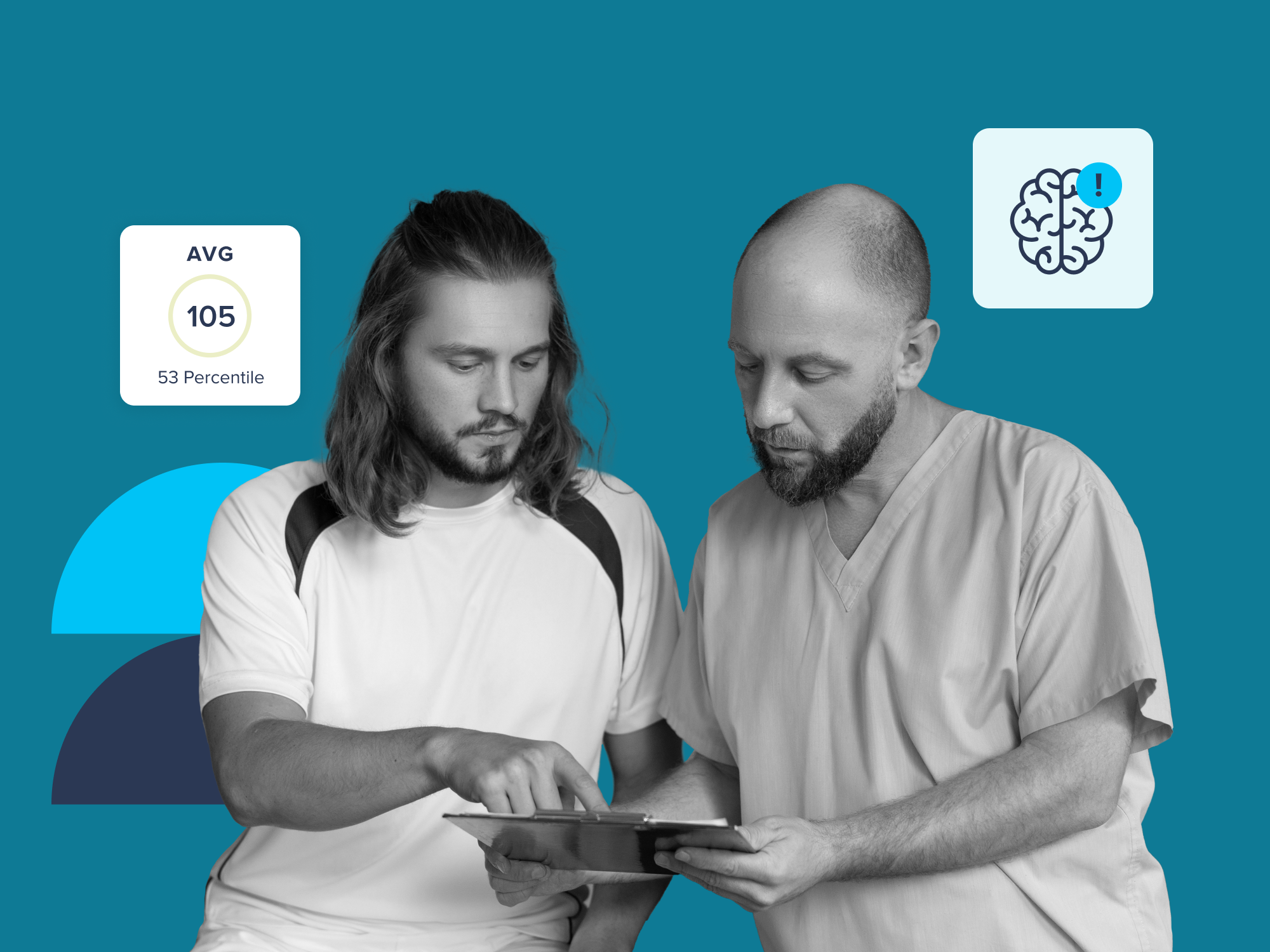
A baseline concussion test measures cognitive and physical function, including coordination and balance, while an individual is healthy and uninjured. Having an athlete’s baseline measurement allows healthcare professionals to compare back to it in the event of a head injury, giving them a personalized benchmark to track recovery against.
Digital cognitive testing is particularly useful for capturing baseline data and assessing the effects of a concussion as soon as it happens. Baseline results play an important role in concussion treatment and recovery, especially for sports-related concussions.
CDC surveillance data recorded approximately 283,000 annual emergency department visits among children for sports-related traumatic brain injuries between 2010 and 2016. About 45% of those visits were associated with contact sports.
This article describes the benefits of baseline testing and how cognitive ability tests can be used to establish baseline cognitive performance data.
Article Highlights
Baseline concussion testing captures an athlete's healthy cognitive function before the season begins, giving clinicians a personalized benchmark to track recovery against if a head injury occurs.
- The CDC estimates that between 1.6 and 3.8 million concussions occur annually in the U.S. A baseline records normal cognitive function across domains like attention, memory, and processing speed, so changes after an injury can be detected quickly and objectively.
- Baseline testing supports three clinical needs: It enables early detection of cognitive change, gives clinicians objective data to weigh against self-reported symptoms, and informs safer return-to-activity decisions.
- Digital cognitive tools like Creyos make baseline and follow-up testing fast and repeatable, so recovery can be tracked over time against a patient's own baseline.
What is a baseline concussion test?
Baseline concussion tests measure cognitive and physical function when an individual is not impaired or injured. They are used mainly for athletes, typically before the sports season starts, because sports, especially contact sports, carry a high risk of concussion.
Baseline testing is essential to detecting differences when screening a patient for a concussion immediately after an injury. It’s relatively quick to retest an athlete to see if their scores are meaningfully different from baseline in the case of a possible concussion.
Baseline testing is also an important part of a concussion treatment plan. Patients can perform the same assessments as they did for their baseline throughout treatment and recovery. These results can then be consistently compared back to their baseline results, in order to see if their results are approaching baseline or are still differing significantly from their expected level of healthy brain function.
Why baseline concussion testing matters
Baseline testing is important because it provides more data, and more accurate data, for understanding changes to a patient’s cognitive performance post-injury, and it offers a personalized benchmark to measure recovery against. With baseline test results, a patient can immediately be screened for a concussion after a head injury. Baseline tests are also an accurate way to track recovery compared to an individual standard and to determine when a patient is approaching their pre-injury levels of function.
The Centers for Disease Control and Prevention (CDC) estimates that between 1.6 and 3.8 million concussions occur annually in the U.S. However, these numbers might underestimate the prevalence, as many people with concussions do not know or seek medical attention.
While concussions in sports are a major concern, concussions have many causes. Any hit to the head or sudden jolt can lead to a traumatic brain injury or concussion, regardless of whether the individual loses consciousness or not. Motor vehicle accidents, workplace injuries, and falls are all common causes of concussion.
Consistent baseline testing can also help get athletes used to the importance of cognitive health care and reduce stigma around concussion diagnosis and treatment.
UCLA Health identifies three major benefits of baseline concussion testing: early detection, objective assessment, and support for return-to-play decisions.
Early detection
Patients may have a hard time determining whether they’re experiencing concussion symptoms immediately after an impact. However, if they can immediately perform the same test as their baseline and their performance has declined significantly, a concussion can be confirmed quickly.
It’s important for patients to get diagnosed and start a treatment plan as soon as possible so as not to exacerbate symptoms and lengthen recovery time. An early treatment plan supports symptom and pain management for patients. The sooner a patient knows they have a concussion and can take steps towards recovery, the better. High levels of either cognitive or physical exertion after a concussion have been shown to worsen symptoms and lengthen concussion recovery time.
Objective assessment
While interviews and questionnaires are important for understanding a patient’s experience of their symptoms, objective tests are also important for concussion treatment. Objective assessments offer cognitive performance data to create a complete picture of the patient’s brain health alongside their self-reported symptoms. These tests are easy to do repeatedly and easy to compare back to, especially when available digitally.
Return-to-play
Returning to regular activities too early can be dangerous and lead to a risk of further injury. If a patient is injured again before the last concussion has healed, this can lead to worse symptoms that last longer.
Baseline concussion tests can assist medical professionals in making return-to-play decisions. It can be difficult for a concussion patient to accurately recall if symptoms have changed since before the injury. Patients may also underreport their symptoms, wanting to return to play, work, or other activities quicker.
How is baseline testing different from sideline testing?
Baseline testing and sideline testing work in tandem to support concussion screening and diagnosis. Baseline testing is done before an injury, while sideline testing is a post-injury assessment done immediately after a head injury.
| Baseline testing | Sideline testing | |
|---|---|---|
| When | Before injury, typically before the sports season starts | Immediately after a head injury |
| Purpose | Records normal cognitive and physical function as a personalized benchmark | Screens for concussion and informs whether to pull the athlete from play |
| Who administers | Healthcare professionals | Trained professionals where available, though responsibility can fall to untrained coaches or sports officials |
| Result | A comparison point for post-injury and recovery testing | A decision on removal from play, pending full assessment by a healthcare professional |
If there is a suspected concussion, the athlete should not return to play or physical activity until they’ve been thoroughly assessed by a healthcare professional. While exercise can be good for the brain, the risk of reinjury or overexertion can negatively affect the cognitive health of a concussed individual.
Trained professionals are not always available on the sidelines. Standard automated tests make it faster to compare against baseline, which makes it easier to manage concussions and to determine whether an individual differs significantly from their usual function. Both baseline testing and sideline testing contribute to concussion diagnosis and recovery, with a baseline assessment being compared to a sideline assessment.
How do you track recovery after a concussion?
Concussion testing can also be used to monitor recovery progress after an incident. Post-injury assessments can be compared to baseline test results, or to sideline test results where a baseline isn’t available. Ongoing testing can be used to track concussion recovery from the time of an incident through return-to-activity.
This monitoring can be done through the Creyos platform, which measures cognitive function through scientifically validated cognitive tasks. Within Creyos, baseline results are compared to current tests to track improvement longitudinally.
Recovery tracking using Creyos
First, a patient can complete a baseline assessment before any concussion occurs. On the Creyos platform, this means administering the cognitive tasks along with a self-report questionnaire such as the Rivermead Post-Concussion Symptoms Questionnaire (RPQ) to establish a baseline for both cognitive performance and symptoms.
Next, a post-injury assessment is completed at the time of clinical presentation. Re-administering the same cognitive tasks and the RPQ in Creyos measures acute cognitive change and captures the severity of any symptoms the patient is experiencing.
Then, providers can use Creyos for serial monitoring. Repeat testing at regular intervals during recovery tracks domain-specific change over time and helps guide decisions about return to activity. When retesting, individual tasks can be administered on their own or as a full set.
What tests are used for baseline concussion testing?
When performing a baseline concussion assessment, a variety of tests can be helpful, since patients will all be affected by concussions in different ways. For example, one patient may struggle with memory but have no issues with balance, while another patient may have an opposite set of symptoms. Patients can be assessed in as many areas as possible to facilitate whole person care.
Examples of concussion tests
Once a baseline has been established pre-concussion, healthcare professionals will need testing tools post-concussion to further track and measure symptoms and recovery. Several concussion assessment tools are available to support this. In this section, we’ll outline some common concussion assessment tools and their different uses throughout concussion care.
- RPQ: This task is a self-report questionnaire that asks patients to rate the severity of concussion symptoms over the last 24 hours. This questionnaire is designed to be taken repeatedly so patients and their healthcare providers can see how their symptoms are changing over time.
- This questionnaire is available with Creyos in digital format and can be completed alongside cognitive performance tasks for a comprehensive view of both subjective and objective concussion symptoms.
- Creyos cognitive tasks: Creyos assessments provide objective measurements of brain function through various computerized tasks. They assess cognitive functions that are often affected by a traumatic brain injury, such as short-term memory, reasoning, and concentration.
- Standard Assessment of Concussion (SAC): This test is designed to measure mental status and to be used immediately post-injury. It doesn’t require a trained specialist to interpret the results and takes about five minutes to complete.
- Sports Concussion Assessment Tool (SCAT-5): This test is designed to be used by athletes 13 years old and above. It takes longer to complete than the SAC and is designed to be administered by a trained professional. This assessment tool has different sections for immediate on-field assessment as well as for office or off-field assessment.
- The child SCAT-5 is a similar test that is designed for athletes 12 years old and under.
- The SCAT-6 is an updated version of the SCAT-5. Both remain in use.
Digital cognitive tests for concussion testing
Cognitive tests can assess neurocognitive functions that are known to be affected by concussions, such as short-term memory, concentration, and reasoning. This is an important part of concussion testing, as cognitive symptoms can persist for a prolonged period, even longer than other symptoms. They can also continue showing effects in the brain under imaging scans, even when athletes have otherwise been cleared to return to play.
To gather baseline scores and for those scores to be usable, sports neurologists and concussion specialists need to be equipped with the right tools. Computerized cognitive tests are one way to help concussion specialists gather the required information.
Computerized cognitive tests can shorten the time it takes to access testing and make retesting highly accessible. Many computerized cognitive tests can be done in the clinic or at the patient’s home without any need for specialized referrals, meaning that healthcare professionals can retain patients in their care and establish continuity of care.
In addition, digital cognitive tests and more in-depth neuropsychological testing can offer a detailed look at various cognitive domains that may be affected by a mild traumatic brain injury, such as memory, concentration, and reasoning.
Creyos cognitive tasks for concussion assessment
Creyos measures cognitive function through the administration of scientifically validated cognitive tasks. Each of these tasks measures a distinct cognitive function that can be affected by concussion. Creyos then automatically generates reports that can be easily interpreted by a provider to measure and track recovery across specific domains like attention, working memory, and executive function.
What Creyos cognitive tasks are recommended for assessing concussion?
The following Creyos tasks are recommended for evaluating cognitive function in individuals with suspected concussion or head injury:
- Double Trouble: This task is used to measure response inhibition. Impaired response inhibition can look like impulsivity, poor decision-making, emotional dysregulation, distractibility, or slowed processing speed.
- Feature Match: This task is used to measure attention. In a concussion, impaired attention can cause forgetfulness, difficulty multitasking, zoning out, distractibility, or even difficulty following instructions.
- Odd One Out: This task is used to measure reasoning in concussion patients. For patients experiencing impaired reasoning skills, they may experience difficulty with problem-solving, decision-making, judgment, and processing complex information.
- Paired Associates: This task is used to measure episodic memory. Episodic memory is a person’s ability to recall specific personal experiences. This can include what they did the day prior or a previous conversation. Episodic memory is one of the cognitive domains most commonly affected in concussion patients.
- Spatial Planning: This task is used to measure executive function and planning. This refers to a patient’s ability to act with forethought and to plan and sequence their behavior to accomplish set goals.
- Spatial Span: This task is used to measure spatial short-term memory. This is a patient’s cognitive ability to temporarily store spatial information (i.e., relationships between objects in a set space). This cognitive skill is used every day in tasks like driving, following directions, or searching for a lost item.
- Token Search: This task is used to measure working memory, the ability to temporarily hold information in memory. This can impact a patient’s function in everyday life, since working memory is essential for holding conversations, organizing tasks, and following multi-step instructions.
Digital cognitive tests from Creyos can help make the overall baseline testing process more convenient for patients and healthcare practitioners alike.
Baseline concussion testing: key takeaways
Baseline testing supports clearer interpretation of post-injury testing, provides a more objective assessment, and informs return-to-play decisions. It is particularly important for athletes, whose sport carries an elevated risk of repeat head injury.
Baseline concussion testing is invaluable when it comes to supporting patients with sports-related concussions. Cognitive assessments are an essential part of concussion baseline testing and can lead to a more complete treatment plan and understanding of patient health.


Reviewed by Mike Battista, Director of Science & Research at Creyos
Mike Battista specializes in brain health, cognition, and neuropsychological testing. He received his PhD in personality and measurement psychology at Western University in 2010 and has been doing fun and useful stuff in the intersection between science and technology ever since.