

Dementia early detection is critical for enabling the best possible patient outcomes and for reducing care costs for health systems. Without a diagnosis, proper care delivery is likely delayed, caregivers can’t properly plan, and costs beyond routine care may be driven up for both health systems and patients.
In 2018, the Alzheimer's Association reported that the care costs for those living with Alzheimer’s or other dementias were projected to surpass a quarter of a trillion dollars ($277 billion). This was the second year in a row that costs were expected to soar so high, and it wasn’t the last. Seven years later, this upward trend continues, with costs on track to reach $384 billion in 2025.
Article Highlights
Recent studies place the rate of people with dementia without a formal diagnosis at 62%, and late diagnosis is associated with higher costs of care.
- In 2018, the Alzheimer’s Association reported that care costs for those living with Alzheimer’s or other dementias were projected to surpass $277 billion, and costs are on track to reach $384 billion in 2025.
- Undiagnosed dementia has been linked to greater hospitalization rates, and research suggests these patients have more 30‐day readmissions than their peers with a formal diagnosis.
- Patient benefits of early detection outlined by the Alzheimer’s Association include additional time to plan for the future, lower anxiety levels about the unknown, and the ability to make decisions about financial and legal matters.
- Alzheimer’s Association recommendations for cognitive tests include an administration time of less than 5 minutes, prior validation in a primary care setting, and easy administration by non-physician staff.
The dementia diagnosis gap and rising care costs
Keith Fargo, Ph.D., former director of scientific programs and outreach for the Alzheimer’s Association, said regarding its 2018 report revealing a sharp increase in Alzheimer's prevalence, deaths, and cost of care:
Diagnosing Alzheimer’s earlier has huge cost-savings implications … Studies show the expenses associated with identification of people with mild cognitive impairment, the earliest stage at which clinical symptoms are present, are lower than those associated with people in the later stage of dementia. In addition, costs are lower once a person with Alzheimer’s gets on the right care path. The disease is better managed, there are fewer complications from other chronic conditions, and unnecessary hospitalizations are avoided. The sooner the diagnosis occurs, the sooner these costs can be managed and savings can begin.
Keith Fargo, Ph.D., former director of scientific programs and outreach, Alzheimer’s Association
One issue that may contribute to rising costs of dementia care is the rate of hospitalizations associated with late and missed diagnoses. Recent studies highlight the gap in diagnosis, placing the rate of people with dementia without a formal diagnosis at 62%.
What are the patient benefits of dementia early detection?
Of course, the benefits of early dementia detection are not solely financial. It has been shown that patients' experiences are improved when they receive care earlier in their dementia journey.
Some of the critical patient benefits of early detection outlined by the Alzheimer’s Association include:
- Receiving the greatest benefits possible from treatment options at the earliest possible point
- Additional time to plan for the future
- Greater understanding of experiences leading to lower anxiety levels about the unknown
- Greater opportunities and chances to participate in clinical studies to advance research
- Opportunities to participate in care decisions
- The ability to make decisions about financial and legal matters
- Additional time to form relationships with doctors and care teams
- Increased access to support services for patients and their families to more easily manage disease progression
What is the cost of a late dementia diagnosis?
Timely diagnosis is an important component of high-quality care. Progressive neurodegenerative conditions, such as Alzheimer’s disease and related dementias, when left undiagnosed have been linked to greater hospitalization rates, resulting in higher financial costs as well.
The early detection of potential cognitive decline through regular cognitive screening can prompt further evaluation of brain health, and clinicians can then seek to address factors that may relate to the patient’s memory loss or mild cognitive impairment (MCI). For instance, severe depression may present with dementia-like symptoms (sometimes called pseudodementia).
Once identified, ruling out these alternative causes and addressing any reversible aspects of cognitive impairment allows practitioners to promptly create targeted care plans and prescribe treatments to help slow cognitive decline in the case of chronic and progressive conditions. Without early detection, these issues go untreated for longer, patients miss out on much-needed interventions, and the cost of care can skyrocket alongside longer hospital stays.
One of the most important considerations of early diagnosis for dementia is the time it gives patients and their families to prepare for the future. While dementia progression can sometimes be slowed, it can’t yet be cured. Having an idea of what the future can hold helps people to plan, build support systems, and arrange their legal and financial affairs. It also allows clinicians to create long-term cognitive care plans with the full participation of patients, accounting for and understanding their wishes.

Poorer patient and caregiver outcomes
Delayed and missed diagnoses can lead to missed opportunities for early interventions and treatments, increasing the burden on patients and caregivers. In addition to missing out on opportunities for intervention, when patients are diagnosed late, their families lose time to process and adapt to their potential new role as caregivers in the early stages of their loved one’s disease, increasing the potential for caregiver strain.
Caregivers who have more time to better prepare for and adapt to the life changes that come with a loved one’s dementia diagnosis often feel more competent in their role and experience fewer psychological problems of their own.
Increased care costs and hospitalization
Late diagnosis is associated with higher costs of care. One reason for this is the association between missed and late diagnosis and increased hospitalizations. Without treatment interventions and supports that often come with a formal diagnosis, untreated dementia can incur more costs through more frequent emergency room visits and preventable hospitalizations than if the disease had been detected and addressed earlier.
Additionally, research suggests that those with undiagnosed dementia or those unaware of their condition experience worse hospitalization outcomes. These patients were also found to have more 30‐day readmissions than their peers with a formal diagnosis.

Alzheimer’s Association recommendations for cognitive screening
The Alzheimer’s Association continually shares new insights, including recommendations for cognitive screening and dementia assessment. These recommendations are a great resource for those looking to leverage the best possible tools for dementia detection.
When should clinicians evaluate for cognitive impairment?
As a primary care physician, here’s what to look for when assessing patients, and some signs that a cognitive evaluation may be warranted:
- When patients express memory-related concerns or cognitive complaints. In some older patients, other, non-memory-related complaints may also be expressed, including personality changes, depression, deterioration of other chronic diseases without explanation, falls, and/or balance issues that could be related to cognitive impairment.
- Upon report of subjective cognitive impairment, either from a patient or their family member.
- As part of an annual wellness visit for Medicare beneficiaries.
The Alzheimer’s Association’s recommendations for cognitive tests
When choosing a cognitive testing tool, clinicians may consider the following recommendations for assessment from the Alzheimer’s Association:
- An administration time of less than 5 minutes
- Prior validation in a primary care setting
- Psychometric equivalence or superiority to the Mini-Mental State Exam (MMSE)
- Easy administration by non-physician staff
- Relatively free of educational, language, and/or cultural bias
The association also notes that for a definitive diagnosis of MCI or dementia, patients with cognitive tests indicative of potential impairment should be evaluated further or referred to a specialist.
Digital cognitive testing makes early detection easier
Digital cognitive testing is an accessible and effective way for clinicians to screen patients who present with concerns of cognitive impairment while reducing the time and cost of testing. Digital assessments can also support earlier and more detailed diagnoses. These tests have been shown to be highly efficient, providing fast and accurate dementia assessment reports.
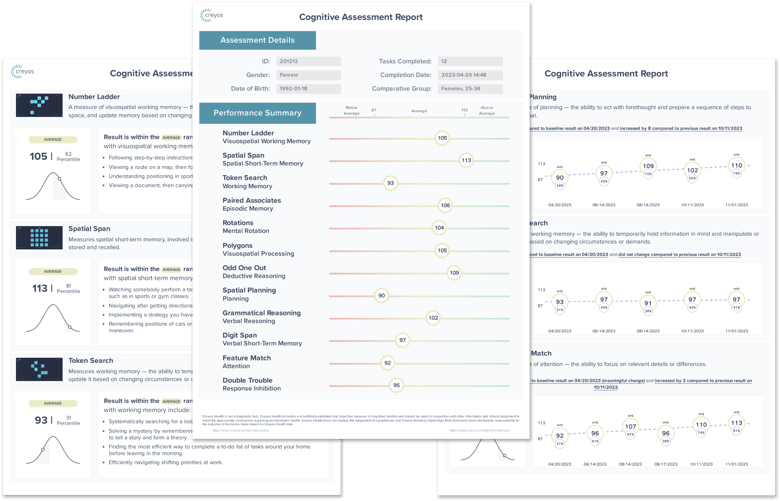
Creyos offers one such digital assessment. The Creyos Dementia Assessment and Care Plan includes a quick, scientifically validated two-task cognitive screener for the initial detection of impairment that takes less than five minutes for patients to complete.
This assessment has the sensitivity to detect subtle signs of cognitive impairment that may be related to dementia. Additionally, the reports generated don’t require training to interpret; the assessment results are easy to understand at a glance. Most importantly, the tests help detect cognitive impairment early, giving clinicians an all-in-one tool to support diagnosis and monitor cognition.
The Creyos assessment bridges the gap between initial screening tests and in-depth neuropsychological evaluations, allowing clinicians to implement thorough, regular testing in-clinic rather than waiting for a specialist referral.
Remote administration
Digital cognitive screening is flexible enough to be administered easily in a clinic or in the comfort of a patient's home. This removes potential travel concerns or other stressors related to in-person appointments for patients and helps to improve accessibility, further promoting health equity.
Sensitivity to mild cognitive impairment
Digital cognitive tests, like those from Creyos, have been shown to be highly sensitive to mild cognitive impairment that may be related to dementia. Creyos tasks also provide domain-level information for detailed insights into patient cognition.
One study showed that a 30-minute digital assessment with Creyos tasks was comparable to a standard 2–3 hour neuropsychological assessment. In another study published in Neuron, it was found that performance on the Creyos cognitive tests was related to distinct brain networks identified by neuroimaging.
Test-retest reliability and longitudinal assessment
Retesting is another important factor for clinicians looking to assess disease progression over time and monitor the effectiveness of interventions. Longitudinal testing gives clinicians critical data insights that are necessary to inform ongoing treatment decisions for patients with dementia. With Creyos assessments, patient performance is compared over time and against norms, with reports clearly showing any meaningful changes or differences so that clinicians can quickly and effectively make informed decisions.
What is the Creyos Dementia Assessment and Care Plan?
The Creyos Dementia Assessment and Care Plan is a comprehensive assessment protocol that gives clinicians the necessary tools to screen for cognitive impairment and assess dementia symptoms in-clinic and remotely.
The dementia protocol includes:
- A quick cognitive screener for initial detection of potential impairment
- A complete cognitive testing battery to help make a more precise diagnosis
- A prepackaged cognitive care plan for caregiver support
Aligned to the Alzheimer’s Association’s recommendations
Creyos aligns with the Alzheimer's Association guidelines, enabling quick screening for measuring cognitive impairment in a patient-friendly two-task assessment. This short dementia screen takes under 5 minutes to complete and can be administered in remote settings or in-clinic. If impairment is detected and further testing is warranted, Creyos also offers a longer, comprehensive 20-minute assessment to establish diagnostic criteria for neurocognitive disorders as part of its Dementia Assessment.
The Creyos assessment is sensitive enough to detect even mild cognitive impairment and enables clinicians to create cognitive care plans that can account for medication, lifestyle changes, risk factors, and support services for caregivers or family members.
Detecting dementia early bolsters patient care and protects your bottom line
Early dementia detection is critical for enabling the best possible patient outcomes and for reducing care costs for health systems. Digital cognitive assessments provide an accessible and effective alternative for clinicians to accurately screen for potential cognitive impairment while addressing some of the existing limitations of traditional cognitive assessments that can make early detection difficult.
In line with the growing need for early detection and the Alzheimer’s Association's recommendations for cognitive screening, digital cognitive testing like that from Creyos provides the detection capabilities that both patients and clinicians need going forward.


Reviewed by Sydni Paleczny, Staff Scientist at Creyos
Sydni earned her MSc in Neurosciences at Western University under Dr. Adrian Owen. Her research explores neuropsychological outcomes after cardiac surgery, with interests in cognitive neuroscience, critical care, and brain health. At Creyos, she supports scientific validity, health technology, and ongoing research.