

Value-based care quality measures reward health systems for outcomes such as lower hospital readmission rates and better chronic disease control, and many of those outcomes depend on patients managing their own care between visits. Cognitive impairment can limit that ability, yet an estimated 92% of expected mild cognitive impairment (MCI) cases in the Medicare population remain undiagnosed. For organizations in value-based contracts, this makes cognition a largely invisible driver of performance on the measures they already track.
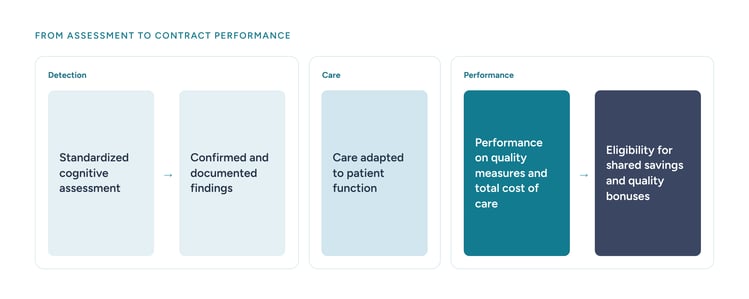
Standardized cognitive assessment brings that driver into view. It gives clinical teams the information they need to adapt care plans to what patients can manage, and it gives the organization a more accurate picture of risk across its attributed population.
The sections below cover how cognition affects performance on major quality frameworks, where current Medicare policy leaves assessment to each organization, and the decisions leaders face in building an assessment pathway, including which population to start with, who owns follow-up, what capacity the work requires, and how to measure success.
Article Highlights
- Value-based care quality measures such as medication adherence, glycemic control, and readmissions depend on patients managing their own care, which cognitive impairment can limit.
- An estimated 92% of expected MCI cases in the Medicare population remain undiagnosed, so cognitive need is largely absent from the claims and health record data organizations rely on.
- Medicare requires cognitive assessment in the Annual Wellness Visit but not a structured tool, which leaves each organization to design its own assessment pathway.
- Standardized assessment helps care teams adapt care plans, document confirmed dementia accurately for risk adjustment, and track change over time. At one full-risk Medicare Advantage organization, it detected dementia at more than twice the previous rate.
How value-based care quality measures work
As payment shifts away from the fee-for-service model, more of an organization's revenue depends on performance on quality measures. As of January 2025, 53.4% of people with Traditional Medicare were in an accountable care relationship, and the Centers for Medicare & Medicaid Services (CMS) has set a goal of reaching all of them by 2030.
| Framework | What it evaluates | Example measures where cognition can play a role |
|---|---|---|
| HEDIS | Health plan performance across effectiveness of care, access, and utilization | Controlling High Blood Pressure; Glycemic Status Assessment for Patients With Diabetes; Plan All-Cause Readmissions |
| Medicare Star Ratings | Quality of Medicare Advantage and Part D plans | Medication Adherence for Diabetes Medications, Hypertension (RAS antagonists), and Cholesterol (Statins) |
| MIPS | Eligible clinicians' performance across quality, cost, improvement activities, and interoperability | Chronic condition control measures, such as blood pressure control, that clinicians select for quality reporting |
| CAHPS | Patients' reported experience of care and health plans | Care Coordination; Getting Needed Care |
These quality frameworks are designed to measure the processes and outcomes of care. The patient capacities those outcomes depend on, including cognition, sit outside their scope. A change in cognitive function often registers only indirectly, as a missed dose, an uncontrolled reading, or a readmission.
Why cognitive health matters for value-based care performance
Cognitive impairment is common in the older populations many value-based contracts cover. A nationally representative study estimated that in 2016, 10% of U.S. adults aged 65 or older had dementia and 22% had MCI.
Because most MCI goes undiagnosed, that need is largely absent from claims and electronic health record data. Risk stratification built on those data can miss patients whose impairment affects their care, and population-level results become harder to interpret, since part of the variation in outcomes may trace to a factor the organization never recorded.
Cognitive impairment as an upstream driver of quality metrics
A care plan relies on the patient to understand it, remember it, and recognize when to ask for help. Memory and executive function support each of these steps. When they change, patients may appear nonadherent or disengaged when the plan exceeds what they can manage without support.
A systematic review of medication adherence in older adults with cognitive impairment identified barriers specific to this group, including understanding new directions and fitting medications into a daily routine. Adherence varied widely across studies, likely reflecting how much help patients received from family or caregivers.
In older adults with type 2 diabetes, an integrative review linked global and executive function impairment with poorer medication management and glucose self-monitoring. Medication adherence and glycemic control are both measured directly in HEDIS and Star Ratings.
Cognitive impairment also shows up in hospital use. Among community-dwelling adults aged 75 or older, MCI was associated with a 17% greater risk of hospitalization than normal cognition, though not with 30-day readmission.
In a cohort of more than 21,000 emergency admissions of adults aged 75 or older, cognitive impairment was independently associated with readmission within 30 days, and patients with impairment but no dementia diagnosis were the most likely to be readmitted. Undiagnosed impairment carried the most risk in that cohort, and it is the form an organization cannot see in its data.
How current policy addresses cognitive assessment
Medicare builds cognitive assessment into the Annual Wellness Visit (AWV) and covers a separate cognitive assessment and care planning service (CPT 99483) when a patient shows signs of impairment. The AWV requirement is broad, calling for assessment of cognitive function "by direct observation, with due consideration of information obtained by way of patient report" and from family members or caregivers. It does not require a structured tool.
The method affects what gets found. In a study cited in the Alzheimer's Association's AWV cognitive assessment guidance, a brief structured tool correctly classified patients with dementia or MCI more often than spontaneous detection by their own primary care physicians (83% vs. 59%).
In 2020, the U.S. Preventive Services Task Force (USPSTF) concluded that evidence was insufficient to assess the balance of benefits and harms of screening asymptomatic, community-dwelling adults aged 65 or older, and an update is in progress. The finding applies only to patients without signs or symptoms. Clinicians are advised to evaluate recognized signs "as appropriate."
Neither policy ensures routine, standardized cognitive assessment across the Medicare population. Each organization decides how to detect impairment, which patients to assess, and what happens after a positive result. That makes the assessment pathway a design choice for organizational leadership, with consequences for care delivery, risk accuracy, and contract performance.
How cognitive assessment strengthens value-based care outcomes
Adapting care delivery to patients' cognitive function
Standardized assessment turns cognition from an impression into a documented clinical finding. A result that suggests impairment prompts the clinician to look for reversible causes, involve a care partner, and decide whether a fuller evaluation or a cognitive care plan is warranted.
The finding also shapes how the rest of the care plan is delivered, since most chronic disease management depends on what the patient does between visits. A clinician may simplify a medication regimen or confirm understanding with teach-back, and care coordinators may add reminders or, with the patient's permission, include a caregiver in follow-up.
These adjustments apply across diabetes, heart failure, and hypertension programs, and they target the adherence and utilization outcomes that quality measures track. The gains come from the care team's response, which the assessment makes possible.
Improving risk adjustment accuracy
Risk adjustment calculates payments based on patients' expected healthcare needs, as reflected in documented diagnoses. When cognitive impairment goes undetected, an attributed population's risk profile understates the complexity the care team is actually managing.
A cognitive assessment result identifies concerns that warrant clinical evaluation. When that evaluation confirms dementia, documenting it with its stage matters under the current CMS-HCC model (V28), which assigns mild, moderate, and severe dementia to separate hierarchical condition categories. The resulting risk scores feed into Medicare Advantage payments and into benchmarks for accountable care arrangements.
Accurate documentation keeps payment aligned with the care a population requires, and it gives care management teams a clearer picture of where that need sits.
Connecting cognitive health to value-based care financial performance
In accountable care, shared savings reflect the gap between a spending benchmark and the actual cost of care, and payouts typically depend on meeting quality standards. Cognitive impairment affects both sides of that calculation. Among more than 8,000 Medicare fee-for-service beneficiaries, cognitive impairment was associated with roughly $6,900 to $7,300 in additional annual healthcare costs, more than half of it inpatient, and those costs were not fully captured by claims-based measures of dementia or comorbidity. Organizations that identify impairment and adapt care accordingly are better positioned to address that spending and the quality measures tied to it.
What standardized assessment surfaced in a full-risk organization
Claremedica, a value-based primary care organization operating under full-risk Medicare Advantage across more than 35 sites in Florida, moved from an MMSE-based approach to standardized digital assessment with Creyos. Over 7 months, the organization completed more than 34,000 assessments and detected dementia at more than twice the rate its previous approach had found.
More than 90% of newly identified patients were in early or mild stages, and more than 80% had been Claremedica patients for years and had already been assessed with traditional tools. The impairment was present in the population all along, outside the organization's data, and identifying it earlier opened time for care planning with patients and families.
Implementing cognitive assessment in value-based care programs
Prioritizing a defined population and clinical use case, such as patients due for an Annual Wellness Visit or enrolled in a chronic disease program, lets a pilot surface completion barriers and staff workload before expansion. Reviewing completion patterns across patient groups, including accessibility needs related to language, literacy, and ability, shows whether a single workflow serves every population.
Each workflow should name who orders the assessment, who reviews the result, and who owns follow-up. Governance should set documentation standards and define how the organization will use aggregate data.
Administering the assessment can fit into existing workflows without specialized staff, and at Claremedica, screening time fell from about 12 minutes with the MMSE to about 6. Reviewing results, arranging further evaluation, and coordinating follow-up still require clinical and care management capacity, which should be planned and resourced before rollout. Results also need to reach the places teams already work, through integration with the electronic health record and the systems used for population health and quality reporting.
Measures of success are best defined before launch. Assessment completion, follow-up completion, and time from a positive result to further evaluation show whether the pathway is working, and the quality measures the organization already tracks, such as medication adherence and readmissions, show over time whether care is changing.
Repeated assessment at consistent intervals turns a single snapshot into a record of change over time, which supports care plan decisions for individual patients and outcome tracking at the program level. Defining in advance what degree of change warrants attention keeps teams from treating every score difference as a clinical event.
Built this way, cognitive assessment gives value-based organizations a measure of a variable that already shapes their results.


Written by Andrea Welsh, LPN, CHPC
Andrea Welsh, LPN, CHPC, is a nurse and medical writer with clinical experience in geriatric, primary care, and behavioral health settings. She has managed quality and compliance programs supporting value-based care in community health centers and holds the Certified in Healthcare Privacy Compliance (CHPC) credential. She speaks at healthcare conferences on data literacy and clinical documentation.