
Routine cognitive tests for seniors are a straightforward way to flag early signs of cognitive decline in the aging population. According to Alzheimer’s Disease International, there are over 10 million new cases of dementia worldwide each year, or one new case every 3.2 seconds. With the number of people with dementia set to continue to rise, incorporating routine cognitive tests into clinical care will play a key role in early detection and treatment.
This article explores the processes and dementia screening tools that help implement routine cognitive testing without increasing costs or administrative labor.
Article Highlights
Routine cognitive testing can lead to earlier detection of dementia, and for patients with cognitive decline, it supports longitudinal monitoring.
- Alzheimer’s Disease International reports over 10 million new cases of dementia worldwide each year, and dementia is expected to be experienced by 139 million people worldwide by 2050.
- On average, patients with dementia are diagnosed 3.5 years after symptoms first appear. Routine cognitive tests capture subtle signs of cognitive decline, allowing patients to get on a path to a referral sooner.
- The world’s largest dementia study found that 62% of healthcare practitioners wrongly believe dementia is a normal part of aging.
- Testing for dementia can be incorporated into the annual wellness visit, and objective cognitive screening tools can flag decline relative to a personalized baseline.
What are the benefits of routine cognitive tests for seniors?
The benefits of routine cognitive testing include:
- Improved access to preventative care measures. While Alzheimer’s disease and other dementias cannot necessarily be reversed, routine testing can lead to earlier detection and shift focus to slowing disease progression.
- Opportunities for advance care planning, allowing patients to advocate for their future wants and needs before advanced disease stages lead to further decline.
- Gathering longitudinal data for ongoing monitoring. Objective cognitive screening tools can flag decline relative to a personalized baseline, provide key insight into how dementia may be progressing, and measure the effectiveness of treatment.
- Speeding up referrals for formal diagnosis. According to Medical News Today, patients with dementia are diagnosed an average of 3.5 years after symptoms first appear. Routine cognitive tests capture subtle signs of cognitive decline, allowing patients to get on a path to a referral sooner.
- Long-term cost savings for both care teams and patients. By 2050, dementia care costs are expected to account for up to 17% of all healthcare spending. Affordable, accessible routine tests help create long-term care plans that keep costs in mind.
Testing for dementia can be incorporated into the annual wellness visit, billed through Medicare, and used to more accurately identify risk adjustment factor (RAF) scores for more effective long-term cost planning.

How do signs of dementia differ from normal aging?
When it comes to dementia, early detection is a priority in senior care, but subtle signs may be missed due to misunderstandings about the disease. In fact, the world’s largest dementia study found that 62% of healthcare practitioners wrongly believe that dementia is a normal part of aging.
Here is how symptoms of dementia stand out from normal aging:
- Memory loss: While occasional forgetting is a normal part of aging, forgetting events more frequently may signify a larger issue. Short-term memory problems that impact daily functioning are common in people with mild cognitive impairment (MCI) and dementia.
- Language difficulties: Patients with dementia often struggle with language and communication. This can look like struggling to find words, difficulty using new ones, or a loss of previous language skills.
- Visuospatial struggles: For people with dementia or MCI, challenges with judging color, distance, or spatial relationships between objects may first appear as trouble with driving or balancing. In geriatrics, falls are also associated with dementia onset.
- Mood changes: Changes in mood or personality, like apathy or irritability, are common behavioral symptoms of dementia.
- Social withdrawal: Ongoing avoidance of social interactions, including places or people, is common in people with dementia or MCI. For seniors, social isolation has also been shown to correlate with all-cause mortality.
- Executive dysfunction: Changes in one’s ability to perform thinking skills like making plans, paying attention, controlling impulses, or problem-solving may be a sign of dementia.
When assessing patients, the severity and frequency of symptoms are important to keep in mind. Objective cognitive screening tools like the Creyos Dementia Assessment are a quick, low-cost way to determine whether certain performance markers or behaviors may be indicative of dementia.
How to incorporate dementia screening into senior care
Implementing routine cognitive testing doesn’t need to add to clinical costs and administrative load. Here are the processes and tools that help keep things simple.
Get to know patients and their families
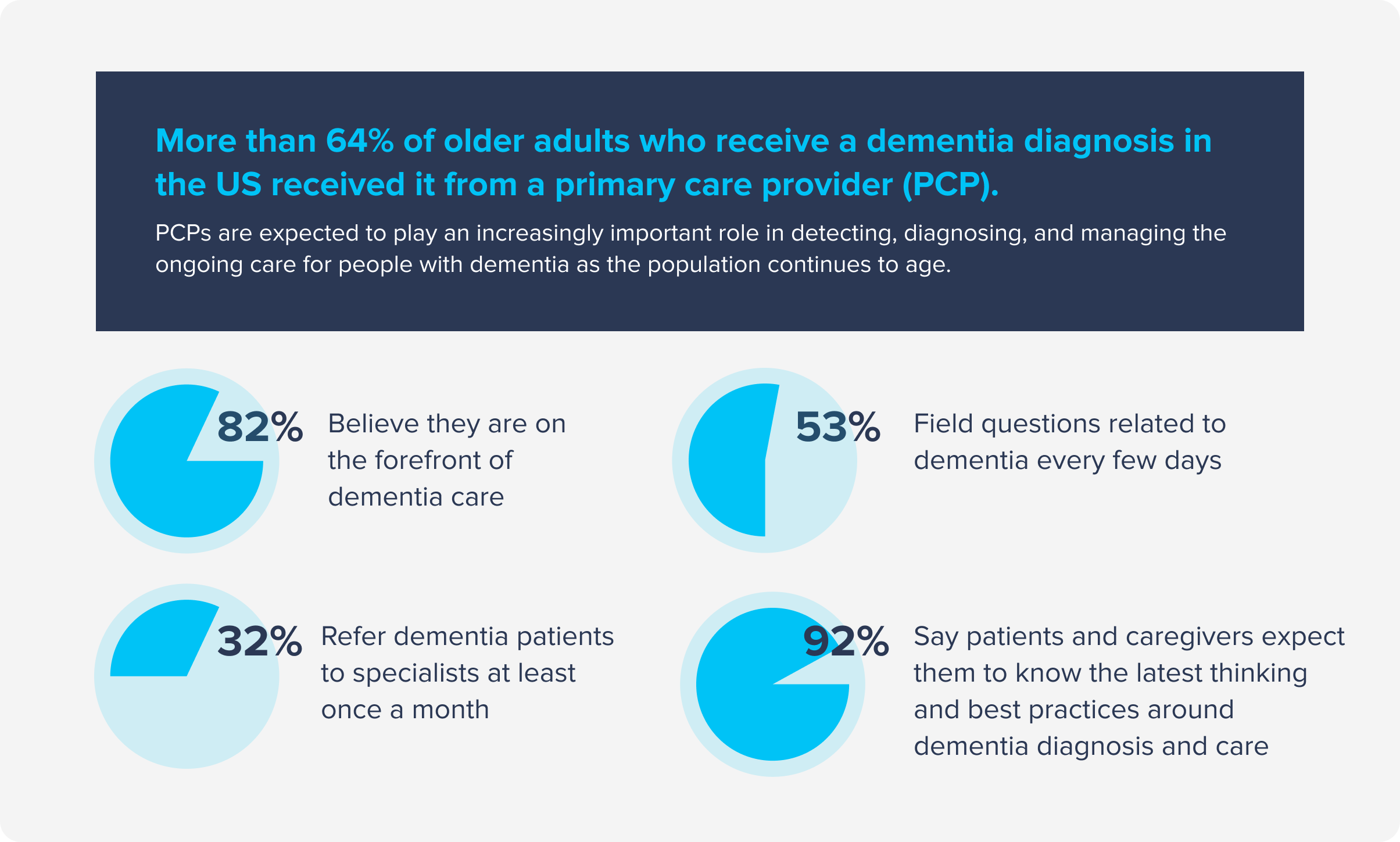
A patient-centered approach is a key part of value-based care, strengthening patient-clinician relationships while keeping health services organized. Getting to know patients as individuals can make it easier for primary care clinicians, as well as geriatrics specialists, to identify when something seems “off.”
The Diagnostic and Statistical Manual of Mental Disorders, Fifth Edition (DSM-5) criteria for dementia (major neurocognitive disorder) include subjective concern of the individual, an informant, or the clinician. Getting to know patients and families can provide more confidence in this diagnostic necessity.
According to the Canadian Institute for Health Information, care partners of people with dementia provide an average of 26 hours of care per week. Connecting with these family members may help give additional insight into patients’ at-home behaviors and help to develop care plans that take caregiver needs and capacity into account.
Use trusted dementia assessments alongside physical exams
Along with routine physical examinations, clinicians can leverage dementia assessments within annual care visits. Digital cognitive tests, like those from Creyos, can effectively assess cognition both remotely and in-clinic. These assessments are short enough to seamlessly fit into an annual care visit while maintaining the scientific validity necessary to accurately flag potential cognitive decline.
Cognitive impairment may be related to disorders other than dementia, like the effects of stroke or untreated diabetes. An annual physical exam is a critical part of understanding how cognition is being affected and whether or not continued dementia testing is necessary.
Gather objective data
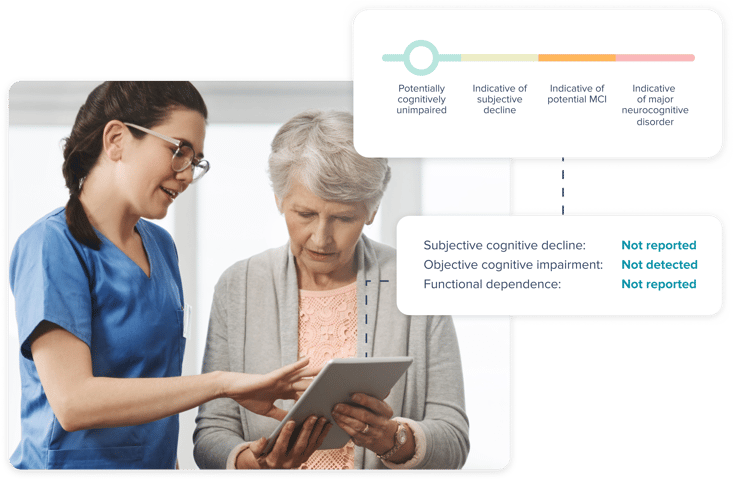
The Creyos Dementia Assessment is designed to have high accuracy when screening for signs of MCI, making it ideal for early detection. It gathers objective cognitive performance data and can be readministered over time for longitudinal testing.
Monitor decline over time
Dementia care is an ongoing process. For patients who have been identified as having cognitive decline, routine cognitive tests support longitudinal monitoring. Alongside a care plan, regular retesting helps determine treatment effectiveness and identify disease progression. For patients who are experiencing a steady decline, results may indicate when it’s time to implement alternate care plans or targeted treatment interventions.
Simplifying routine cognitive tests with the Creyos Dementia Assessment
The Creyos Dementia Assessment gathers the objective data necessary to support the early detection of dementia and other neurocognitive disorders. The assessment can also be easily integrated into primary care settings for uncomplicated regular testing of senior patients.
The assessment is sensitive enough to capture mild signs of cognitive impairment and includes:
- A five-minute, two-task screen to identify potential age-related cognitive impairment
- A twenty-minute assessment of cognition and other dementia criteria to help support a diagnosis
- A prepackaged cognitive care plan that’s personalized to patients’ individual needs
The online cognitive tasks measure multiple domains, which have been shown in previous research to be impaired among people with dementia or MCI:
- Reasoning
- Short-term memory
- Verbal ability
You can read more about the way cognitive tasks are used to screen for dementia in our Dementia Protocol Science Overview.
The Creyos Dementia Protocol also includes questionnaires like the Informant Questionnaire on Cognitive Decline in the Elderly (IQCODE), Instrumental Activities of Daily Living (IADL) Questionnaire, Patient Health Questionnaire (PHQ-9), and Generalized Anxiety Disorder scale (GAD-7). These subjective measures help clinicians understand patients’ mental health, document subjective concerns, and assess daily living skills, all components of an informed dementia diagnosis.
The Creyos Dementia Assessment simplifies rapid screening for primary care clinicians and helps neurologists reach more precise diagnoses and identify comorbidities. With reports that automatically integrate into electronic health records (EHR), this information can be easily shared among patients’ healthcare teams.
For clinicians looking to assess conditions other than dementia, Creyos also allows you to easily administer custom cognitive assessments and additional brief screeners for seamless integration into annual visits.
Want to learn more about how Creyos can help your clinic perform routine cognitive testing? Read about how cognitive assessments helped Yukon Neurology bring their assessment time down from 6 hours to 2 while also improving patient experience with simple, gamified cognitive tasks that could be performed on a tablet. These improved processes let clinicians see an average of 30 patients a day and complete 10 neuropsychological exams weekly without sacrificing quality of care.
Why routine cognitive testing matters for an aging population
Dementia is one of the most feared conditions, and by 2050, it’s expected to be experienced by 139 million people worldwide, according to Alzheimer’s Disease International. In order to meet the needs of the aging population, clinicians will have an increasing need for routine cognitive testing.


Reviewed by Sydni Paleczny, Staff Scientist at Creyos
Sydni earned her MSc in Neurosciences at Western University under Dr. Adrian Owen. Her research explores neuropsychological outcomes after cardiac surgery, with interests in cognitive neuroscience, critical care, and brain health. At Creyos, she supports scientific validity, health technology, and ongoing research.